The Wall Street Apostle

In the aftermath of the 2008 U.S. presidential election, the word “change” is still on everyone’s lips. Change was the central theme of both campaigns and the exclamation point in President-Elect Obama’s victory speech: Change has come to America!

What strikes me as strange about our American enthusiasm for change (and count me in as someone who wants to see change!) is that at the moment we are knee deep in changes we didn’t vote in, yet are powerless to stop. The current global financial crisis has us watching daily stock exchange reports like soap opera fanatics. Everyone is on edge. The unpredictable shifts and surges of global politics and power are introducing changes that are frightening and changes that create exciting new opportunities.

Lately, I’ve been thinking a lot about change, not so much because of the election, but because of a large box UPS deposited on my porch last Spring. Inside was a 1500 page manuscript (over 10 inches thick!)—a commentary on the Gospel of Matthew that I had agreed to review. The timing was terrible. I didn’t know whether to laugh or cry. What happened afterwards has been eye-opening for me.

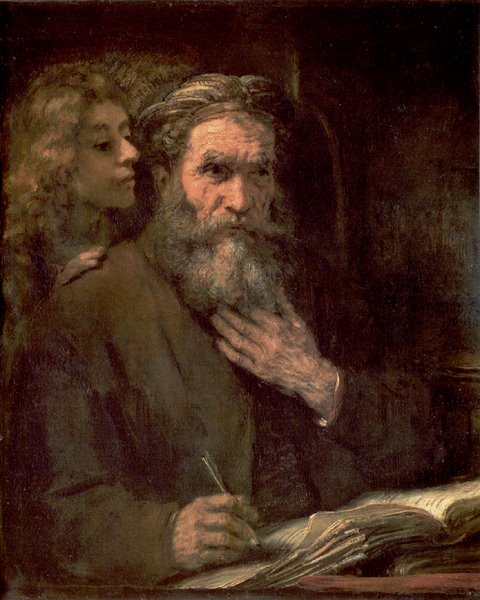
Before that box arrived, I never paid much attention to Matthew. He’s one of the forgotten apostles who gets eclipsed by the more prominent figures—Peter, James and John. Yet, as I started thinking more about Matthew’s story and how it smolders beneath the surface of his writing, his Gospel started to come alive for me, so much so that I haven’t been able to stop thinking about it.

Take for example what Matthew is teaching me about change.

Anyone who knows Matthew’s story knows he desperately needed change. Caught up in one of the most notorious, unethical, and lucrative professions in Israel, Matthew was a charter member of the club of individuals about whom it is fair to say, “Greed got the best of them.” I have a hunch that if Matthew were alive today (at least the pre-disciple version of him) he’d be right in the middle of the current financial crisis as part of the problem.

His job was to collect taxes for the occupying Roman government from his fellow Jewish citizens. That was bad enough. But as the deal went, he could pocket whatever extra he could squeeze out of hapless tax payers, which is exactly what he did.

Like today’s golden-parachute CEO’s, Matthew’s financial prosperity came at a steep personal price. First century Israelite tax collectors were among the most despised members of Jewish society. Instead of gaining stature from his impressive portfolio, Matthew was shunned and mistreated in a hundred different ways. Pharisees spoke of tax collectors with utter disgust. No doubt Jesus’ other disciples found it hard to stomach the admission of a tax collector to their inner circle.

Matthew is one of several biblical characters (like Rahab the Harlot and Simon the leper) who never seemed able to shake his past. Although other biblical writers graciously drop the derogatory descriptor, in his own Gospel he stubbornly lists himself among the other disciples as “Matthew the tax collector.” Evidently it was important to Matthew that we remember where he was when Jesus found and rescued him.

But Jesus isn’t simply in the business of saving souls. He’s in the business of bringing change. There’s a kingdom to restore, and Jesus’ agenda for change begins with people. Matthew is “Exhibit A.” Jesus called Matthew to “Follow me!” (Matthew 9:9). A call for change is embedded in Jesus words. Change was also implicit when Jesus called others to, “Repent, for the Kingdom of heaven is near” (Matthew 4:17).

I never put those two imperatives together until recently. When I did, I began to wonder if I had stumbled upon clues to Jesus’ strategy for change—golden safeguards, if you will, designed to keep believers moving steadily along the path of Kingdom change that Jesus means for us to travel.

The Greek word for “repent” means “to change your mind.” It’s not enough to quit a corrupt tax collection business and find a more suitable line of work, although that was surely a start for Matthew. Nor is repentance confined to occasional moments of remorse over lapses along the way, although that is important too. These narrow definitions of repentance can leave us thinking we’re doing just fine—that repentance is for others. Which is exactly what the Pharisees thought. The true definition runs much deeper, exposing the most godly, mature believer to profound reasons to repent.

Repentance addresses the fact that at a systemic level we are all out of alignment with our Creator and with our noble calling to be His image bearers. God Himself pointed out the utter seriousness of our problem when He said,

“My thoughts are not your thoughts, neither are your ways my ways. As the heavens are higher than the earth, so are my ways higher than your ways and my thoughts than your thoughts.” (Isaiah 55:8-9).

According to God, that’s a pretty wide gap, and we all suffer from it. Jesus’ call to repent summons us to work at change, at shedding layer by layer our kingdom-of-this-world thoughts and ways, at making intentional strides towards becoming who God created us to be. Admitting and reminding ourselves that we are out of alignment with God is the place for us to start.

Make a U-turn. “Repent, for the Kingdom of heaven is near!”

“Follow Me!” completes the thought by identifying where we need to go and who is here to help us. Matthew’s Gospel is unambiguous when it comes to defining the changes Jesus has in mind. Matthew pursues change for himself by spending time with Jesus. Studying His ways. Weighing His words. Comparing himself to Jesus. Repenting the disparity and imitating what he observes in Jesus. And all the while, Matthew himself is gradually changing—embracing a Kingdom perspective on money, a Kingdom attitude towards society’s outcasts, and a Kingdom selflessness that contrasts sharply with the grasping life he left behind.

Read Matthew’s Gospel and see what a recovering tax collector wants us to know about change!

Posted in Uncategorized | Leave a comment

The Shack

19e6i2unmfdfhjpg

There’s a rickety old shack in the Oscar winning movie, Forest Gump, where Forest’s best friend Jenny grew up. Jenny’s shack is also the place that hides her darkest, most painful memories—early years of sexual abuse.

After they reach adulthood, Forest and Jenny revisit the shack. It is a powerfully wrenching scene when Jenny, enraged by the memories she cannot shake, hurls fistfuls of rocks at the hated shack. Later, Forest finishes the job by flattening it with a bulldozer. But the ill-effects of childhood suffering are able to withstand Forest’s demolitions efforts.

Paul Young’s runaway bestselling novel, The Shack, takes up a similar theme.

The shack in Young’s tale is the site where Missy, the beloved young daughter of the main character Mack, is brutally murdered by a sexual predator. The impact of her brutal death on Mack is, as you can imagine, utterly devastating. Like Forest’s friend Jenny, Mack lives a tormented life because of what happened to his little girl in the shack. The shack casts a dark and terrible shadow over his life that he can’t escape.

The shack—that dilapidated vacant old eyesore—comes to represent unspeakable loss and an open wound in Mack’s soul. Just like Jenny, Mack returns to the place most abhorrent to him, drawn by a note in his mailbox signed “Papa”—the name his wife Nan uses most often for God. But unlike Jenny’s story, Mack’s story doesn’t include a bulldozer scene. Instead of trying to destroy the shack, Mack enters it alone. He is angry, skeptical, fearful, and filled with revulsion.

Yet it is in returning to the place that pains him most that Mack has a life-altering, redemptive encounter with God.

Young’s novel has attracted an enormous readership which, in itself, would be reason enough to discuss his book here. He has also drawn fierce criticism from Christians for his portrayal of the Trinity and for his theological views which he is audacious enough to put into the mouth of God.

From my vantage point, it seems counterproductive to debate, when Young is serving up to us on a platter an amazing opportunity for deep conversations and real ministry with so many people. We may not like every detail of the book or agree with every theological statement it contains. (And in all fairness, Young’s critics should also inspect C.S. Lewis and Tolkien, not to mention their own views, under the same theological microscope.) But Young is doing here what most people do every day. He’s asking the tough theological questions that hound every wounded soul. (If you’re not in that demographic, sooner or later you will be, so this is for you too.)

Why do bad things happen—not just in the abstract, but to me? Does God really care about me? Why is my life such a mess, if God is truly good?

And here’s one to ponder: How do we present God as Father to this father-starved generation and call them to draw near to Him, when the mention of “father” conjures up images that are uncaring, distant, and (in more cases than we’d like to admit) abusive? Young tackles that question head on by starting in the kitchen with “Papa” represented as a warm, embracing African-American woman and leading Mack from there to know “Papa” as Father who will shepherd him gently through the hardest stretches of his journey.

I suspect one explanation for the skyrocketing sales of this book is that there are a lot of hurting people in this world who long for an honest discussion of the big questions they are already asking. Young is giving them that discussion.

I read and discussed The Shack with six highly respected, theologically minded people. All seven of us are seminary graduates with years of experience in theology, biblical studies, and pastoral concerns. You may be surprised to learn that our discussion touched only briefly on the theological controversy and then went in another direction. Yes, we are all seminary graduates capable of wading into the controversy. But we have another thing in common which changed our reading of Young’s book.

We all have shacks.

If you’re hurting—if there’s a painful, immovable fixture on the landscape of your life—this book will touch you in your deepest place. It did that for all of us. Frank and I felt a deep connection between Mack’s struggles and the shack we are dealing with in the aftermath of his brother Kelly’s death in the snow cave on Mount Hood.

The Shack is about revisiting the hard places—the shacks—of our lives and wrestling honestly with God there (instead of avoiding, ignoring, or trying to bulldoze it). Somehow God meets us in our shacks. This is the consistent story of God’s people all through the Bible: Job, Abraham and Sarah, Naomi, Hannah, David, and Jeremiah, to name a few.

The Shack is about being reassured of God’s relentless love for you in the presence of your greatest reason to doubt Him. How ironic for Mack to come to grips with God’s love at the murder scene of his daughter where God’s love seemed so wholly absent. I’ve always said, I’d rather hear about God’s love from someone who believed they had lost it, than from someone whose rosy life never forced them to doubt.

The Shack is about the importance of the hard places in our lives. In our victorious, prosperity-obsessed, air-brushed Christianity, we completely miss this. There’s a lot of truth to the charge coming from people who are leaving the church that we are not honest about the shape of our lives and the state of our faith. In the church, shacks are secrets unless something unforseen blows your cover. Shacks are shameful. And the doubts they produce are signs of spiritual failure, not the path to growth.

I don’t necessarily advocate full public disclosure of our deeply private struggles, but there surely is a place for us to acknowledge to one another that we all have spiritual struggles, we wrestle with doubts about God, and we all have our shacks.

Biblical sufferers offer us that kind of honesty, and we should be grateful that Paul Young has been that honest too.

Have you read The Shack? What was your response?

Note: If you’re interested in reading a thoughtful review, here’s a more extensive analysis by Professor John Stackhouse, who personally interacted with the author at Regent College, Vancouver, BC:

Posted in Uncategorized | 12 Comments

Flip-Flopping

The selection of Alaska’s Governor Sarah Palin to the GOP presidential ticket has put a working mom in the headlines. This mother of five has not only galvanized her party’s ticket, she’s created a stir that isn’t exactly what you might expect.

Democrats are suddenly questioning how a working mom can take on the vice presidency and still do justice to her family. Republicans insist it’s no big deal and are applauding her choice to run. Politicians are often accused of flip-flopping, but this is a doozy!

Working moms and stay-at-home moms who are familiar with this discussion can’t help feeling a bit disoriented by the surprising reversal of opinions. I must admit it has taken me aback. Costly sacrifices made by both groups of moms, nights of complete exhaustion, endless multi-tasking, a firm resolve to steward our gifts and callings, unswerving commitment to family, and a determination to tackle head-on the demands of the unique personal circumstances God places before us—suddenly seem thrown into a chasm of confusion.

Whatever else you might say about Sarah Barracuda, the hockey mom from Alaska, she has turned family values upside down. Liberals are taking up the cause of stay-at-home moms. Conservatives are advocating for working mothers. What is the world coming to? Whichever side of the divide you’re on, you’ve been betrayed by those you thought were cheering for you.

My own life as a mom has never fit neatly into either category. At times I’ve been fulltime in the corporate world. At others I’ve blended work and home, career and family. I’ve even taken a turn as a home schooling mom. In every stage of my life, there have been solid reasons for my choices. But, like a lot of other women, every choice has been accompanied by that nagging sense (reinforced by raised eyebrows and comments I’ve heard along the way) that I’m “not doing things right.”

As a mom who worked to support my husband’s academic career, I recall looking wistfully out the window of our third floor Oxford flat at moms who were getting together with their little ones. I felt torn between my longings to be part of that group and the project deadline facing me that would put food on the table. But there were also wonderful reminders of the importance of what I was doing. Once, during a business meeting, I reached into my briefcase and pulled out a miniature Elmo that my preschool daughter had tucked inside to keep me company.

Governor Palin—standing at the podium with her husband in the bleachers cradling their infant son in his arms—has unintentionally reshuffled the deck and forced on us questions about God’s calling on women’s lives in a rather public way. Only this time we aren’t asking on behalf of women, like my mother, whose days of active mothering are over. Nor are we asking for single and childless women who have yet to be admitted to the mom’s club (although we need to ask questions for them too). This time we’re asking for a mom who has major challenges at home and yet is answering a call to be doing something above and beyond traditional roles.

I keep coming back to the ezer-warrior, who leads us beyond this political flip-flopping. (If the ezer-warrior concept is new to you, go here.) In embracing the ezer as my identity as a woman, I find the courage and the freedom I need to embrace the particular life God is giving me—whatever that might be.

So far, the first ezer is the only woman to be born (so to speak) into a perfect world. The rest of us have had to cope with unexpected changes, catastrophic tragedies, fluctuating economies, disappointments, opportunities, and a lot of messiness. Walking into life armed with a tightly scripted formula for how a woman ought to live her life doesn’t equip us for the contingencies we encounter. In fact, it often ties our hands behind our backs just when we need to step up and fight a battle we never expected to face.

We need a compass that enables us to embrace God’s purposes for our lives today—no matter what particular complexities we face. By embracing our calling as ezer-warriors, we can cheer each other on, instead of splitting into hopelessly divided camps.

So, what do you think?

Posted in Uncategorized | 11 Comments

One World One Dream

The 2008 Beijing Olympics are over. Athletes have returned home. Those with medals are making public appearances and raking in endorsements.

We have moved on too and are focusing again on the presidential election and political conventions. At the same time, we have come away with a whole new set of Olympic memories we will add to those we’ve accumulated over the years.

For me, some of the strongest images are not from athletic feats, but from the opening ceremony—a lavish, jaw-dropping celebration of the 2008 One World One Dream Olympic theme which I can’t quit thinking about.

The entire program created powerful images of unity and solidarity, beginning with the thunderous performance of 2008 near-perfectly choreographed Chinese drummers. Watching them felt a bit like getting stuck in a room full of mirrors. A reporter for the Chicago tribune wrote, “The emphasis was not on individuals, but on masses of performers, meticulously trained and coordinated.” Talk about oneness!

Oneness is, or surely ought to be, a major topic of concern among Christians. It was high on Jesus’ list of priorities. He prayed fervently that we would be one. The apostles followed with astonishing talk of us being one body. We’ve been struggling with the notion ever since.

According to Jesus, far more is at stake in our oneness than peace and tranquility among believers. Our oneness is supposed to send a message to the world that Jesus truly came from the Father and that the Father loves us as he loves Jesus (John 17:20-23). Our oneness authenticates the divine nature of Jesus mission because the oneness He produces among His followers thrives in a sea of differences and defies the laws of human relational gravity.

Jesus seems to have something far more challenging in mind than what was happening in Beijing. If His start-up band of followers is any indication, Jesus chooses people that make His task infinitely more difficult and the outcome far more impressive than what is achieved by synchronizing 2008 young Chinese men of the same height, weight, build, haircut, and attire.

Jesus chose four Jewish fishermen then added the hated Matthew, who was ingratiating himself to the Romans and enriching himself by overtaxing his Jewish neighbors including, some believe, the fishing industry. With only the first five disciples in place tensions already thrive among Jesus’ followers. Tensions escalate with the inclusion of Simon the Zealot, a political loyalist with zero tolerance for a Jewish defector like Matthew.

Jesus wasn’t finished. Luke tells us He included women, which made no sense to His male disciples who, at one point, were dumbfounded to find Him even talking with a woman (John 4:27). Little did they realize He wasn’t just talking with her, He was recruiting her for His cause. Then Jesus calls Paul whose assignment is to break the news that Gentiles are part of Jesus’ plan. Instead of making oneness easier, Jesus is making it harder.

What binds Jesus’ followers together is not our sameness, but our firm allegiance to Him and to His cause in the world. We will never dot our theological I’s, cross our political T’s, or beat our worship drums exactly the same way so long as we live in a fallen world. Deep differences will always exist among us. But our differences are what give our oneness the unique power to communicate to the world that Jesus has come and is making a difference in our lives—bringing hopelessly diverse individuals together into one united Body.

“See how they love one another” will leave lasting images in the world’s mind when we love one another, not in sameness, but in the midst of our differences.

Posted in Uncategorized | 1 Comment

Kingdom Operatives

Scandal broke out in Washington D.C. in 2003 when The Washington Post exposed Valerie Plame Wilson as a covert operative on weapons of mass destruction. The political uproar that ensued over this damaging leak of classified information was clearly warranted.

What the story broke for me was my stereotyped ideas of government spies. Anyone on the look-out for the manly, James Bond-type of secret agent would be completely fooled by this attractive blond forty-year-old wife and mother who for twenty years worked as an undercover agent on one of the CIA’s most dangerous missions.

All of the intrigue, intelligence, and danger you might find in the stories Valerie Plame could tell, are present in the stories of women in the Bible who were often called upon to move out of their comfort zone and take unexpected risks to address injustice, undermine evil plots, and advance the kingdom of God on earth. And, like many covert operatives, they acted courageously while unaware of the vital piece their actions in the immediate setting contributed to the achievement of the master plan.

Queen Esther is an obvious example. Under the ominous threat of genocide, even Mordecai acknowledged young Esther had been divinely stationed “for such a time as this.” After months of advising his cousin covertly from outside the palace walls, he could now do nothing but await Esther’s instructions. The crisis jarred her out of focusing on maintaining her personal safety to risk her life for a bigger cause. The Jewish nation counted on her to piece together palace intelligence she had gathered from her privileged insider position as King Xerxes’ queen. Ultimately, she maneuvered masterfully through palace politics to overthrow the enemy’s plot.

Less obvious is the story of Ruth the Moabitess. No one I know thinks of Ruth as a covert operative, but that is just the point. Unlike Esther, whose story took place in the highly visible arena of world power, Ruth operated under the radar in the margins of society. When adversity drove Naomi’s family into Moab, who imagined she’d return bringing with her a key kingdom operative on whom so much would depend? Who would suspect a young non-Jewish female immigrant of carrying out so vital a kingdom mission as the one God entrusted to Ruth?

Ruth’s movements were confined to the realm of ordinary family concerns, making it easy to miss the fact that global matters were at stake in her activities. She was putting food on the table, caring for her grieving mother-in-law, marrying, giving birth, and later (along with Naomi) raising a little boy. It wasn’t The Washington Post that blew Ruth’s cover, but the biblical narrator of her story who announces at the very end that the family she battled to save is the royal line of King David which, turns out, is the promised line of Jesus. Although Ruth never knew it, without a doubt, the whole world was counting on her actions.

The strategy God implemented at creation—to advance his kingdom through the efforts of his male and female image bearers—rose to new heights when Jesus mobilized all of his followers to disperse throughout the earth with the gospel. A secular journalist, analyzing different religious movements, remarked,

“It is an explosive concept, with the potential for unleashing creative Christian energy in many areas of endeavor—ordinary lay-women and men, indistinguishable from their colleagues and neighbors, going about their normal occupations, who nevertheless “catch fire” with the gospel and change the world.”

Most of us don’t live our lives on the dramatic scale of a Valerie Plame, an Esther, or a Ruth. But their stories are important reminders that more is always going on than meets the eye. As image bearers, ezers, and as Christians, we are part of a cause that is greater than our individual lives. God strategically stations His ezers where there is kingdom work to do. That alone lifts our everyday lives—our words, our actions, our relationships—to a higher level of significance.

The stories of Esther and Ruth also raise questions about notions that God prefers to do important kingdom work through men, that passivity and dependency are acceptable qualities in anyone who follows Jesus, or that He only occasionally calls on women to do important kingdom work if and when the men are absent or falling down on the job.

Both Esther and Ruth had to dig down deep and summon up levels of courage, wisdom, and strength they never knew they had in order to do the work God was calling them to do. No one would rescue them. They needed to rescue others.

Neither woman operated in a vacuum of godly male leadership. To the contrary, they collaborated with two of the strongest male leaders in the entire Old Testament—Mordecai and Boaz. Both men were blessed and grew stronger because of the heroic initiatives of the women.

It’s wonderful to imagine what might happen if each of us took our lives this seriously. How would it change things if instead of leaning on others, we viewed ourselves as covert kingdom operatives? If we actively embraced our responsibility to live out the gospel, to advocate for others, battle for justice and mercy, and advance the kingdom one square inch of earth and one life at a time?

When my cell phone rings and someone I care about is on the line wondering if I’m doing anything and if I want to “hang out” for a while, it just might be an opportunity for a covert operation.

Posted in Uncategorized | 2 Comments

Deployed!

The Best Sermon He Ever PreachedThis past April my family gathered in Oregon to celebrate my parents’ 65th wedding anniversary. While we were together, my brothers and I produced a list of statistics from 65 years of marriage that sound a little like stanzas from The Twelve Days of Christmas—4 kids, 8 grandkids, 9 great-grandkids, 12 moves, 4 pastorates, 5 dogs, 1 cat, 3 goldfish, countless hamsters, and a parakeet (but no pear tree as I recall).

None of these statistics surprised us. But what did surprise me at least was to see on paper the fact that of their 65 years together only 33 were with kids at home (and that’s almost certainly well above the average). For 32 years and counting it has just been the two of them.

If we include the years from the day my mother was born until she married my dad, she’s been on active duty as a mom for less than half of her life. What is more, 10 years ago debilitating pain took my mother out of the traditional role of a wife she so beautifully fulfilled for most of her adult life and sent my dad to the kitchen. Here’s another statistic to ponder: 9 out of 10 wives end up spending some portion of their lives alone, a staggering number that doesn’t include women who never marry.

Looking at the numbers and the real lives they represent, shouldn’t we be asking some pretty penetrating questions about God’s calling for women?

For example, do the answers we embrace fully address the many changing seasons and circumstances of our lives? Is it possible for some women to finish the job God created them to do long before their lives are over or, even worse, to miss entirely God’s main purpose for creating them? Are we putting little girls and young women on hold until they marry and have children? Is it possible that at any moment some unexpected tragedy or misstep can downshift our lives from significant and purposeful, to marginal and no longer vital? Are God’s purposes for women that fragile? Was an older divorced friend of mine right when she murmured dismally, “I had my chance”?

If my mother’s story didn’t raise questions for me, the women I’ve encountered during the past five months would have done the job. In the first few months of this year, my path has crossed with those of gifted women in ministry and in seminary. I met courageous women at Fort Bliss, in El Paso, Texas—wives of U.S. servicemen who are single-handedly managing the home front in an atmosphere of daily uncertainty, as they track and support husbands stationed in Iraq and Afghanistan. There were others—a group of remarkable business women in Orlando who are making a difference for the kingdom in the corporate world; Hispanic women in South Florida who have emigrated to this country and are coping with seismic alterations as they try to restart their lives; even an online community of several hundred heartbroken but faith-filled women battling for the souls of children who have turned prodigal.

Anyone attempting to define a common demographic among these various groups of Christian women would have to give up in frustration after checking off “female.” The demographics don’t line up. Neither do their circumstances. Their lives are not all the same. And in this broken world, change is an ever present reality, if not an outright threat as it certainly is for the women of Fort Bliss. If a woman’s highest calling is to be a wife and mother, as we in Christian circles so often assert, then a lot of us are having to settle for something less, often through no choice of our own. And even for women like my mother who marry and raise children, large chunks of their lives fall outside the scope of God’s calling for women. Can it be possible that in planning for us God failed to take into account the myriad of contingencies we inevitably encounter?

All of this leads me to look again at the strong military Hebrew word ezer (pronounced āzer)—the label God gave His daughters when He created the first woman. Is ezer a part-time job for women that we take up for a season and lay down when the nest empties or if we land among the high percentage of women who end up on their own? Or do marriage and motherhood come under a much larger umbrella of God’s purposes for us that encompass the whole of every woman’s life and drench every day of our lives with kingdom purpose?

If ezer is this all-encompassing, then my mother is still deployed and has been since her birth. She is still a warrior on active duty, still fully engaged in advancing God’s kingdom right where He has stationed her. My divorced friend hasn’t run out of chances either. And my new friends at Fort Bliss were speaking for all of us when they said, “Our calling as ezer-warriors for God’s purposes is exactly what we need to march us forward through our lives.”

Posted in Uncategorized | 6 Comments

May Update

Image by Wilhelm Eder from Pixabay
By the time May arrives, if you’re anything like me, you’re ready for a break. This spring seems to have been busier than ever, but this is actually a good thing. Looking back, I am both amazed and energized by all that has happened. God has blessed in so many incredible ways. Here is just a sampling:

Synergy2008 is the history books now. Thanks to all of you who attended and all who prayed. The weekend was incredible. Women gathered in Orlando from all over the United States, Canada and overseas. Many churches, ministry organizations and seminaries were represented.

This was the first year Gifted For Leadership co-sponsored the Synergy conference with the Synergy Women’s Network. We are thrilled to have them on our team!

Here’s what one woman (who came from China just for the weekend) wrote:

I was overwhelmed by the outpouring of God’s kindnesses and encouragements to me throughout the weekend! The whole conference felt deeply rooted in both heart connections to pursue the Lord and strong biblical/theological foundations to fuel such a fire. The writing track in particular was extremely helpful towards practical tips and excellent resources. I left feeling empowered and energized to pursue this gift!

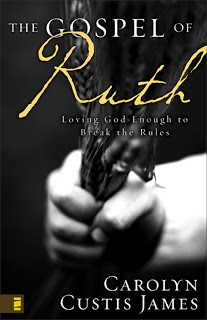
Here’s a surprising piece of news: Barely two months after its release, The Gospel of Ruth is already in a second printing! If you haven’t had a chance to read it yet, you might want to add it to your summer reading list.

Posted in Uncategorized | 5 Comments

Gift of the Ezers

A friend of mine knows exactly how to create the perfect Christmas for her family. Visiting her home in December is like stepping into a Hallmark card or one of Budweiser’s “I’ll be home for Christmas” commercials—the ones with the Clydesdales pulling the sleigh through the snow that used to make me cry the first time I celebrated Christmas away from home.

Those Martha Stewart touches we all admire, that are embedded in our best Christmas memories (or fantasies), are a long way away from the raw courage and gritty determination that characterized women’s early contributions to Christmas. In the midst of all the hustle and bustle of Christmas, it’s easy to forget the heroic young ezers who risked everything to make that first Christmas possible.

Mary of Nazareth comes immediately to mind—the young teenager who sacrificed her girlhood dreams to join a cause that cast a dark shadow over her reputation and ultimately broke her heart. We’ve lost sight of the fact that there were two courageous young mothers and two miracles babies born in Bethlehem. Without both babies, there would be no Christmas.

Ruth the Moabitess doesn’t show up on Christmas cards, but she belongs there just the same.

Although separated by multiple generations, Ruth’s and Mary’s stories run on parallel tracks. Both were unmarried when they sensed God’s call on their lives. Both traveled great distances under stressful conditions to reach Bethlehem. Both made radical choices and costly sacrifices. Both had miracle pregnancies and gave birth to significant sons in Bethlehem. Both women heard and responded to a voice that gave them every reason to fear. But faith not fear drove their actions which ultimately blessed the world.

There are important differences too. Mary was betrothed—to Joseph, a man of extraordinary character. Her dreams were intact and her future secure (at least before the angel appeared). But any dreams Ruth may have had as a young girl had already gone up in smoke by the time she was in her mid twenties. She was certifiably barren—a disastrous label and an unspeakable sorrow in a culture where women were valued by their ability to bear sons—and then she was widowed.

Who would imagine God singling out a woman like Ruth to play a crucial role in His redemptive purposes for the world? But that’s exactly what He did.

The voice Ruth heard was not the angel’s proclaiming “Emmanuel”—God with us, but her bereft mother-in-law Naomi lamenting Yahweh’s departure. “The LORD’s hand has gone out against me!” Yet just as clearly as Mary heard the angel’s voice, Ruth heard God’s call at that dark moment.

What fascinates me about Ruth’s story is the fact that she moved forward without the benefit of the heavenly perspective that Mary enjoyed. Ruth saw her life from ground level the same way we see ours. From that earth-bound vantage point, her life didn’t look anything like a Hallmark card. Once in Bethlehem, she joined the ranks of gleaners—reduced to scavenge for a living.

But just like Mary, Ruth said “Yes” to Yahweh. She embraced the battles God placed in her path and determined to do whatever it took to put food on the table and to rescue Naomi’s family from the awful fate of extinction.

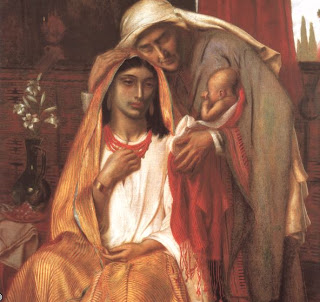
In the end, both young women gave birth to sons in Bethlehem. Mary laid her baby in a manger. Ruth laid her baby in Naomi’s empty arms.

Of course, Ruth didn’t know she was getting ready for Christmas. She had no clue that God’s purposes for the world were hanging on the courageous choices she was making or that the family line she was fighting to save would one day produce the promised Messiah. From her ground-level point of view, Ruth was only putting one foot in front of the other to take care of Naomi.

And Mary would certainly need someone to explain to her that all the jingle bells, last minute shopping, and hoopla we go through each December are connected to the miserable ordeal she endured when she gave birth to Jesus in a make-shift maternity ward with Joseph as her midwife.

In a strange way, as Christmas approaches, the way these two women prepared for Christmas is a gift to me. Neither of them ever saw a heart-warming beer commercial, a Hallmark card or a Christmas tree. Christmas for them meant saying “yes” to God. Meant costly choices. Meant moving out of their comfort zone to fight a battle and take up a cause that humanly speaking was impossible.

Most years, I believe I can manufacture the perfect Christmas for my family. This year, I know up front I won’t be able to pull it off. There’s too much loss and heartache in my family at the moment to convince anyone that life can be perfect—even on Christmas Day.

Perhaps instead of striving to produce the kind of Christmas that is unrecognizable to its originators, I’d be better served by bringing their Christmas into mine—a Christmas that admits I need a Savior to rescue me. That centers on saying “yes” to God’s calling on my life and to the battles He is calling me to fight. That looks at life from ground level, sees the messiness, the confusion, the impossibilities and yet believes that what is happening here is part of the bigger story He is weaving.

Who knows? This may be the best Christmas yet.

Posted in Uncategorized | 6 Comments