Higher Math

Image by Alicja from Pixabay

It has been a long time since I was in a math class. But the other day, while listening to Garrison Keiller’s Writer’s Almanac on NPR, I was suddenly back in the classroom.

He was reading Jessica Goodfellow’s poem entitled “The Invention of Fractions.” I stopped what I was doing to listen.

In his smooth baritone voice, Keillor began,

God created the whole numbers:
the first born, the seventh seal

I was about to get a thought-provoking lesson in Higher Math.

The reading continued . . .

Ten Commandments etched in stone,
the Twelve Tribes of Israel —
Ten we’ve already lost —
forty days and forty nights,
Saul’s thousand and David’s ten thousand.
‘Be of one heart and one mind’ —
the whole numbers, the counting numbers

It took humankind to need less than this;
to invent fractions, percentages, decimals.
Only humankind could need the concepts
of splintering and dividing,
of things lost or broken,
of settling for the part instead of the whole.

Only humankind could
find the whole numbers,
infinite as they are, to be wanting;
though given a limitless supply,
we still had no way
to measure what we keep
in our many-chambered hearts.

It’s been almost three months to the day since Search and Rescue volunteers found my husband’s brother Kelly’s body in the snow cave on Mt. Hood. I know a lot of you were praying, and both Frank and I are grateful for your prayers and notes of support

As you can imagine, the grief and disappointment for my family are still raw. And I’m still processing everything that happened—from the upsetting midnight phone call telling us Kelly, Brian and Nikko were in trouble to the awful day the search effort was downshifted from “rescue” to “recovery.”

I’m still intrigued by how the story captivated and inspired the nation. We thought this was a private family crisis. Yet countless people watched and wept and prayed and cared deeply about the fate of our three guys right along with us. It’s difficult to explain such a phenomenon.

I can’t help thinking that at least one reason people were drawn to the story may have been because (if for only a brief moment in time) we were witnessing the kind of whole-number living Goodfellow writes about. The kind of unity God intended for the human race from the beginning.

With three men in trouble, scores of people voluntarily banded together as one, solidly united behind the mission of bringing the climbers back alive. It didn’t seem to matter that they didn’t know Kelly, Brian, or Nikko. It didn’t matter that many were strangers to each other or that there were countless differences among them. Somehow none of that got in their way. They dropped what they were doing, strapped on their gear, and headed for the mountain, ready to do whatever they could to find and rescue the three lost men.

The first mathematical equation in the Bible gives us a hint of the kind of whole-number world God envisioned from the beginning. When he created the first man and woman and gave them a monumental mission, he said—the two “will become one flesh.” It’s a higher form of math that doesn’t easily compute in our world. Not only do we have trouble pulling it off in our relationships, even modern technology resists it. No calculator or computer—no matter how sophisticated or how many times you try—will ever tell you one plus one equals one.

Jesus takes the equation even further. According to His calculations, it doesn’t matter how many “ones” you add together, the final sum will always be one. This is His heart for us. And no matter how solidly united SAR volunteers were on Mt. Hood, Jesus means for His followers to surpass them in whole-number living.

Jesus final prayer for us—His dying wish—was “that all of them may be one, Father, just as you are in me and I am in you. . . . May they be brought to complete unity to let the world know that you sent me and have loved them even as you have loved me” (John 17:21, 23).

I don’t know about you, but I’m thinking I still have a lot to learn about math.

Posted in Uncategorized | 7 Comments

Feeling Better Yet?

After the death of a loved one—or any other sorrow or loss—there is the expectation in the minds of many Christians that the sorrower should put their grief aside and move on with their life. Our troubles are like hurdles placed in our path to test our spiritual fortitude. It’s a sign of spiritual maturity (so we tell ourselves) to rise above the pain or at least to conquer it at some point. The goal is to surmount successfully these miserable hurdles and get on to the smooth stretch on the other side. Someone who months or years later still feels depressed, still talks a lot about their loss, or whose eyes still well up with tears at the mention of their loved one, just doesn’t know how to let go.

As much as others expect it of us, no one wishes to walk away from grief more than the person who is grieving. And we are hard on ourselves when our broken hearts don’t heal. After the death of his beloved wife, Joy, to cancer, a broken C. S. Lewis admitted it was hard to get beyond his grief. In his poignantly personal book, A Grief Observed, he exposes the fallacy of this kind of thinking.

“To say the patient is getting over it after an operation for appendicitis is one thing; after he’s had his leg off it is quite another. After that operation either the wounded stump heals or the man dies. If it heals, the fierce,continuous pain will stop. Presently he’ll get his strength and be able to stump about on his wooden leg. He has ‘got over it.’ But he will probably have recurrent pains in the stump all his life, and perhaps pretty bad ones; and he will always be a one-legged man. . . . At present I am learning to get about on crutches. Perhaps I shall presently be given a wooden leg. But I shall never be a biped again.”

The intriguing thing about Lewis, and other suffers like Job and Naomi, is that the lingering pain is actually purposeful—actually opens a conversation with God (heated and intense at times to be sure), but one that wouldn’t occur otherwise. They’re asking questions about God that their pain provokes, and they’re looking at Him through their pain. Forever after a major part of them was always missing, and there was a distinctive limp to how they walked. Their lives were shaped and deepened and defined by their losses and the wrestlings with God that ensued.

If we’re not careful, we can use Scripture or one or two key theological precepts to short circuit that conversation. God’s sovereignty over our circumstances or over the number of our days doesn’t blunt hard questions about God, but rather provokes them. Why bother questioning God if He was wringing His hands over the weather on Mt. Hood? Why be upset with Him if He wasn’t around or He was helpless to protect the three climbers from their deaths? No, God’s power, presence, and love are the very reasons we are troubled when He doesn’t intervene to spare us from painful losses, and we are swamped in grief.

Christian philosopher, Nicholas Wolterstorff, shared Lewis’ perspective when his son died in a mountain climbing accident. “The world has a hole in it now,” Wolterstorff lamented, “I shall look at the world through tears. Perhaps I shall see things that dry‑eyed I could not see.”

Are we feeling better yet? No. Not really. For God and we have work to do. According to Lewis, there will always be a limp. According to Wolterstorff, there will be growth and we will come to know God better. In the meantime, there are questions to be asked and wrestling to be done. But we have every hope that through our tears, we will see things that dry-eyed we could not see.

[Note: This post also appeared on the MtHoodClimbersBlog]
Posted in Uncategorized | Leave a comment

Unfinished Business

When Frank and I returned home from Kelly’s funeral, I was thinking that (except for a couple of final notices) the blog I had maintained during the crisis on Mt. Hood had pretty much served its purpose and should simply go to sleep. The rescue effort is over. Three grieving families have gone home. The media packed up their cameras and microphones and moved on to other stories. There really didn’t seem to be much more to say. Then I started having second thoughts.

It is a worn out metaphor, I know, but after all has been said and done, there is an elephant in the room—a big, glaring, cumbersome load of uncomfortable questions that, to be honest, most of us prefer to ignore. But to stop here and not face head-on the uncomfortable issues that this crisis has raised—raised in public, no less—is to turn away from the central issue of this entire ordeal and cheat ourselves of the kind of honest reflection we all need.

Looking back over what happened, anyone can see that we were set up for a miracle. All the pieces were in place. We had a desperate crisis. SAR experts were on the scene, well-equipped, ready and eager to tackle the mountain—willing to risk their lives to bring the missing climbers safely home. Resources, technology and volunteers poured in from all directions. Family members boldly spoke words of faith on network television. “Courage and hope”—how we clung to those words. God’s people everywhere mobilized to pray. Media cameras zoomed in and all America watched.

Yet, to our great dismay, there was no miraculous clearing of the skies. No stilling of the storms. No stopping of the winds. Instead, blizzards moved in with record fury, driving rescue workers off the mountain for the most critical days of the search. Everyone poured themselves into the effort and, to be completely honest, it seemed as though the only one who didn’t cooperate in the whole rescue operation was God.

The book of Job opens with a man of faith on his knees and a God who seems to work against the prayers of His child. It is utterly mind boggling, but after only two chapters faithful, righteous Job’s whole life stands in ruins. But the book doesn’t stop there. It goes on—for forty more chapters—to talk about the elephant in the room. Where was God when disaster fell? Why didn’t He step in and do something? What kind of God is He anyway? Are we wasting our time to put our faith in Him if He turns His back when we’re in trouble and crying out for His help?

Some of us are already wrestling with these questions—not just in the situation involving Kelly, Brian and Nikko, but in our private struggles with unanswered prayer and lives that are filled with disappointments, heartache, and loss. Our troubles mean these questions are personal, not academic. Much is at stake for all of us. We want to understand the God who holds our lives in His hands and whose ways so often defy our understanding.

And so, for a while, the Mt. Hood Climbers blog is going to continue. I think we have some unfinished business that we all need to address. I hope you will stick with us—not with the expectation of getting all your questions answered, but with the intent of being honest with God, with how life looks, with what faith in God is all about. These questions are under discussion in our home. I want to take the conversation online. Frank will be joining us. I think a lot of us are interested in hearing his thoughts on these matters.

If you have questions you’d like discussed in this forum, feel free to raise them in the comments. We can’t promise to cover everything, but we want to at least try to take this discussion to the next level.

May God meet us as we struggle to understand Him.


http://mthoodclimbers.blogspot.com

Posted in Uncategorized | Leave a comment

A New Beginning?

New Year’s Day has always been a favorite holiday for me. Having grown up with three brothers, I naturally associate it with good food and lots of football, minus the pressures Christmas creates. At a personal level, I like the pause for reflection and resolve that January brings and the sense that this is a new beginning, a fresh start, a chance to do a lot of things better than I did in the year that has just closed.

This year, I’m struggling to find that sense of new beginnings. Instead, I have a strong awareness that a lot of 2006 is traveling with me into 2007. For my family, 2006 ended on an all-time low with the death of my brother-in-law, Kelly James, on Portland’s Mt. Hood. There isn’t any way to leave that heartache behind.

But for all of us, the past is always part of the present, as well as a shaping influence in our future and on us. We carry baggage from the past with us, no matter how desperately we’d like to leave it behind. Despite the obvious negatives (the extra weight, the drag on us, and the dysfunction baggage can produce), our inability to shake the past is a good thing in many respects. God uses the experiences, disappointments, and heartaches of the past to take us deeper in our relationship with Him. In the process, we gain wisdom and become more sensitive to the struggles of others. I felt this deeply during the search and rescue effort on Mt. Hood and in the grief that followed, because I’ve been especially helped by the comfort I’ve received from people who are in a lot of pain themselves.

A major goal of WhitbyForum is to encourage women and men to pursue a deeper relationship with God. I’m discovering that God does some of his best work in us through wounds that don’t seem to heal and in the residue left behind by painful chapters in our lives. The baggage we’re all carrying around are important opportunities to go deeper with God. If you want to explore this subject more, join my husband Frank and me in an online discussion of the hard questions about God that life’s realities provoke: http://mthoodclimbers.blogspot.com/
Posted in Uncategorized | Leave a comment

Come and Behold Him!

Anyone who has ever had a baby knows the world becomes a friendly place when you have a baby in tow. Strangers in the grocery store, the post office, or the mall, who would otherwise walk right past as though you didn’t exist, suddenly have the time to stop and chat. They even do a bit of flirting—making silly faces and funny noises—hoping to get a gurgled chuckle or a toothless smile from the little one perched in the shopping cart.
I wonder if it wasn’t something like that when Joseph and Mary arrived at the temple to dedicate their baby to God. As the young family entered, two senior citizens waiting inside turned their heads. If they were anything like folks in the canned vegetables aisle, their faces brightened and they moved closer, just to catch a glimpse of the baby the youthful mother was carrying.

We really don’t know much about Simeon or Anna. Like those strangers shopping for groceries, their brief encounter with Mary and her baby only lasts a moment. When it’s over, they move on, and we never see them again. But the moment is unforgettable—enough so that when Doctor Luke heard about it much, much later (presumably from Mary), he knew this story had to go in the book he was writing. What seems on the surface as just one of those chance meetings, goes down in history as one of the most important events in Simeon and Anna’s long lives, and was certainly one Jesus’ mother never forgot (Luke 2:22-39).

After living for so many years, both Simeon and Anna had seen a lot of life and had drunk deeply of this world’s sorrows. Luke gives us more demographics on Anna, so we know she was once married, heading down the expected path for young women, imagining herself as the mother with the baby everyone wants to see. Instead, seven agonizing years passed without a successful pregnancy. She was, by all accounts a disaster as a wife, for her job as a woman was to produce sons for her husband. Anna didn’t even produce daughters. On top of the heartache that surely took up residence in her soul, Anna’s husband died. If she married in her early teens (which is almost certain), she entered widowhood in her early twenties. It was the worst possible outcome for any woman and one that relegated her to live out her days in the margins of a society that had little use for her.

In a culture that identified a woman by her husband and her sons, Anna reverted back to going under her father’s name. Luke introduces her as “the daughter of Phanuel, of the tribe of Asher.” We don’t know her husband’s name. It’s as though she never had a husband. It may also indicate that after her husband’s death her in-laws threw her out—a common fate for widows in third world cultures. And since Anna’s barrenness was common knowledge, she was crossed off as a potential candidate for remarriage in any matchmaker’s book.

How many hundreds of times did Anna bump into young mothers with their babies over the years and feel a stab of sorrow in her heart? Today in the temple that old pang was gone. The sight of this mother and child caused her spirits to soar.

We don’t have any details of Simeon’s story. Like the generation among us that still remembers the horrors of WWII, he and Anna were old enough to recall stories of the days when the invading Romans conquered Jerusalem and their lives were changed forever. Since their late teens or early twenties, they had lived under Roman occupation. Gentiles were in power, and the Jews were an oppressed people. Such sorrows are foreign to most of us, but they weighed heavily on their hearts. Both were waiting… had waited for decades for the moment before them now.

Anna and Simeon didn’t decorate trees, send out cards or shop for presents in anticipation of Christmas. They fasted and prayed. Both were prophets, and God revealed to them that this was the child they had waited for all their lives. They understood that their private hopes and the hopes of the world were answered in the baby cradled in his mother’s arms.

The troubles that occupy our hearts—that we try to put out just for a day or two to enjoy (or endure) the festivities of Christmas—are the reasons Jesus came. The hurt in Anna’s heart, the shattered dreams, the endless lonely years she spent on the fringes of society are reasons Jesus came. The reign of fear in today’s world, the hunger, pain and suffering we see on faces around us and in the evening news, the abuse of power, the rise of tyrants, and rampant injustice are reasons Jesus came. All of the troubles that make Christmas so hard for so many are reasons Jesus came.

In the grocery story, a little baby has the power to bring a smile to a total stranger’s face and just maybe give a lift to a heavy heart. But the baby in the temple brought far more than a smile. He brought help. The baby Jesus was on a rescue mission, reconnecting this broken world with the God who created it, giving us a reason—not just for the season—but for living and hoping and staying in there when the going gets rough. When Simeon reached out and took the infant Jesus in his arms, he was embracing hope.

Simeon didn’t live to see how it all turned out. He already knew it wasn’t going to be easy. But even knowing more sorrow lay ahead, even for the baby’s dear mother, Simeon died in peace knowing the darkness was defeated—a light had broken through—for Israel, for the Romans, and also for us.

And the widow Anna, a woman of sorrows, makes her final appearance in a burst of joy. She may have been disqualified from a woman’s role in her culture, but God gave her a staring role in his story. God placed the woman, who never got to welcome a baby of her own, first in line to welcome this one. She is the first evangelist, the first to proclaim the Good News that Jesus is the promised King who has come to deliver us. Her message is one we all need to hear.

Maybe this Christmas we’ll all stop, if only for a moment, to come and behold the baby, to share the peace of Simeon and enter the joy of Anna. Come, let us celebrate the light that has broken through our darkness.

“The light shines through the darkness,
and the darkness can never extinguish it.”
—John 1:5, NLT

Posted in Uncategorized | Leave a comment

Breaking Down Walls

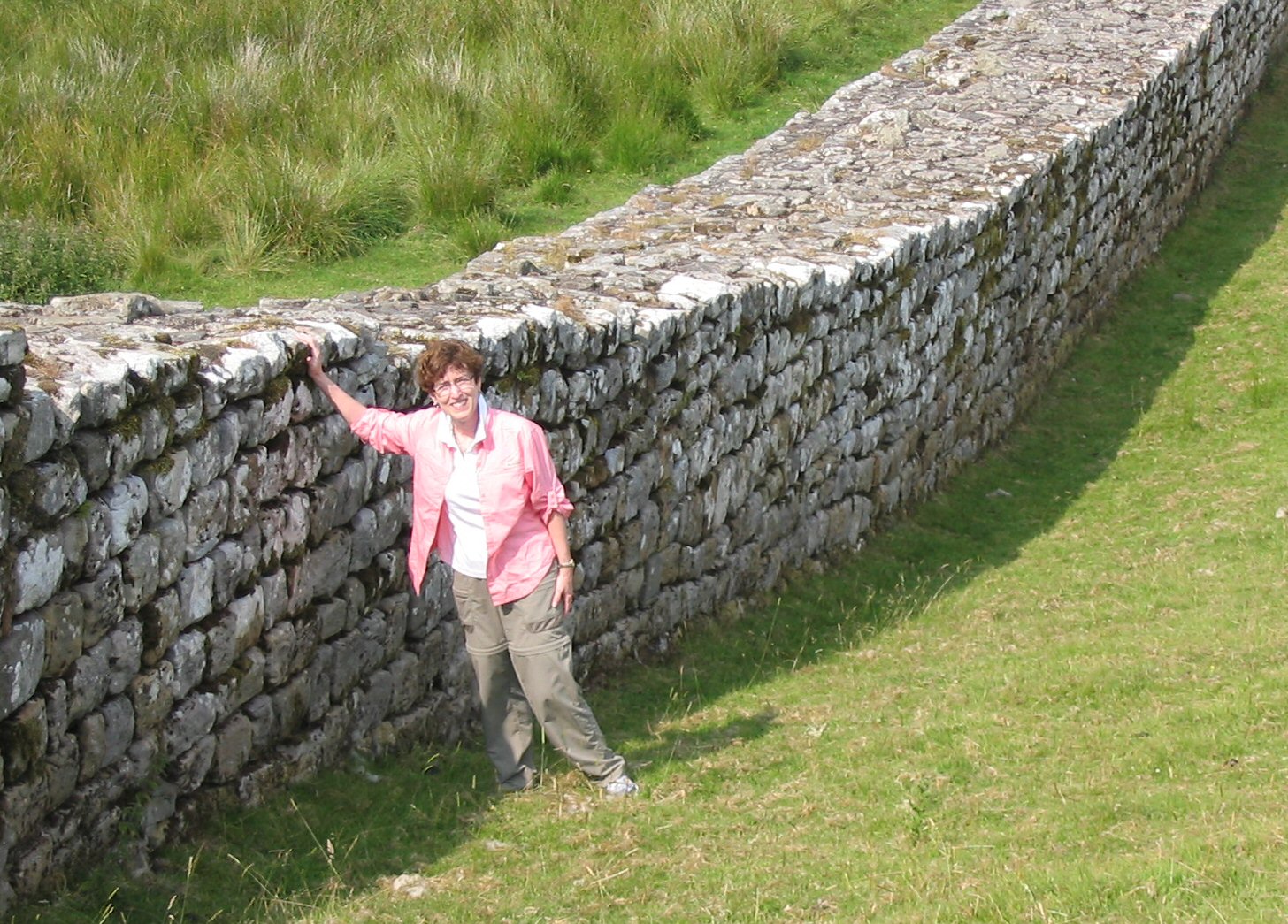
When Frank and I hiked Hadrian’s Wall in England, back in 2006, we covered long stretches where no trace of the ancient Roman wall remains. Lots of sheep and cows and picturesque English countryside, but no wall.

Built to last, the original wall ran 84 miles in length, east to west across Northern England near the Scottish border. Fifteen feet high and eight to ten feet wide, the wall was dotted with mile castles and turrets along the way. Hadrian’s Wall established a formidable barrier between the Roman civilized world to the south and (my apologies to readers who may be Scottish) the barbarians in the north. Yet, over the centuries, farmers (so we were told) pilfered stones from Hadrian’s Wall to build houses and churches until in many places the massive wall simply disappeared.

Apart from archaeologists (and a few hikers), no one is lamenting the current state of Hadrian’s Wall. In fact, one could argue that the crumbling of Hadrian’s Wall is a good thing—a hopeful symbol on the world’s landscape that tells us deep-seated hostilities can subside. I found that harder to believe, as we hiked during the day and caught BBC World News in the evenings. Fighting between Hezbollah and Israel, civil war looming in Iraq, and casualties in Afghanistan—just a few of today’s dividing walls, erected from the stones of hatred and hostility.

In a world of walls—those in the news and those we routinely bump into in our personal relationships—hope can take a beating. We could use a word of encouragement.

ABC news anchor Charles Gibson once reported that “we don’t usually look to the Middle East for uplifting stories.” But one of ABC’s reporters had found one. In the aftermath of a Hezbollah attack on an Israeli border town, two Jewish brothers—both husbands and fathers—lay dead. A third surviving brother, devastated by grief, was nevertheless determined to do more than bury his brothers. He took action to donate his brothers’ organs. Among the waiting candidates was an Arab man who was losing his sight and who was completely dumbfounded and humbled to receive the gift of sight from a Jewish victim of an Arab missile. A successful cornea implant restored sight to the man and broke through a barrier most people would have thought was impenetrable. Who would believe that a grieving Jewish man and an Arab could weep together, embrace and call each other “brother”, while in the distance the battle continued to rage?

Gibson was right. We don’t expect to find hope in the heat of the battle. But then, those who are living with the horrors of war know how precious peace is and are willing to take extraordinary measures to achieve it.

Even more encouraging (and also sobering), I think, is the fact that Jesus is so fiercely committed to tearing down the walls that divide. He took costly measures to bring true peace to a broken, embattled world. You’d think that, given his commitment, he would handpick followers who had been matched by the most rigorous personality screening. Instead, he has an unsettling way of bringing people together who have nothing in common and are sometimes a lot like combining nitro and glycerine. But this is where the power of his gospel shines through. And he has more in mind for us than a cease-fire or teaching us how to “get along.” He wants us to become so united to him and to one another that we function as the members of a healthy physical body—his Body.

That’s something to ponder.

Big things are at stake in how Christians relate to one another too. Jesus casts a vision for us that demands the radical kind of bridge-building displayed by those two former enemies in Israel. “Father,” He prayed for us, “may they be brought to complete unity to let the world know that you sent me and have loved them even as you have loved me” (John 17:23). According to Jesus, there’s an awful lot riding on the state of relationships among those who follow him and the kinds of peace-makers we become in the world. The quality of our relationships sends a message to the world that Jesus has come and that we are beloved of the Father.

Proof showed up in Africa when the paths of two African women crossed. The two arrived as grief-stricken refugees at the same Christian shelter in Kenya, only to discover they were from warring tribes. The men in their family—husbands, brothers and sons—had been brutally murdered by men from the other woman’s tribe. One can only imagine the intensity of animosity and pain as the two women came in contact. The potential for vicious conflict between them was frightening. But the gospel of Jesus Christ took root. As the two women began to grasp what Jesus had done for them, the wall between them simply collapsed under the sheer weight of his grace and forgiveness. I don’t want to minimize the struggle it took, but in the end, the two women embraced each other as sisters in Christ.

As a hiker, I admit I was disappointed that more of Hadrian’s Wall hasn’t survived and I enjoyed most those segments of the hike where ruins of the ancient Roman wall still stand. As a Christian, however, I am compelled to side with the farmers. Jesus calls me to join him in dismantling the walls.

Posted in Uncategorized | 2 Comments

God is Good for Women

I was the third child born in my family—the first and only daughter. My parents were thrilled, of course, just as they were when each of my three brothers was born. In my family, the birth of a daughter wasn’t accompanied by the sudden deathly silence that comes in other parts of the world when parents discover their newborn is a girl. Born elsewhere in the world, I might have been regarded by my parents as a disappointing interruption in their steady string of boys.

Recently, I heard of a Jordanian father, living in the west and married to a North American, who was delighted at the births of his first three children—all girls. However, each time it took him days to gather up courage to phone and tell his parents. When his wife finally gave birth to a son, he grabbed the phone immediately and dialed Jordan. His mother made a high-pitched trilling noise to celebrate the news.

Sometimes a cultural devaluation of females can take on more sinister form, with atrocities like female infanticide being among the worst. Historically, Christians have stood in the gap and still are doing so today. In the early church, believers quickly gained a wide reputation for rescuing abandoned female infants, taking them into their homes and raising them as their own. In the early 20th Century, Amy Carmichael pioneered the Dohnavur Fellowship, a work in India dedicated to the rescue of little girls who were being sold by their families into temple prostitution. Today, scores of Christian organizations are reaching out to war and AIDS widows, providing shelter, teaching them skills so they can support themselves, and above all giving them the gospel. These actions comport perfectly with the Bible’s mandate for us to care for the orphan and the widow. The Bible doesn’t stop with rescue efforts and mercy ministries, however, but compels us to rethink this widespread notion that women have less value than men.

Consider, for example, the story of two sharply contrasting individuals in the Bible—Jairus and the unnamed woman with the hemorrhage (Mark 5:21-43; Luke 8:40-45). Their lives ran parallel for twelve years, then intersected suddenly when both became desperate for Jesus’ healing touch.

Twelve years earlier, separate events started the pair on paths that were destined to collide down the road. Jairus’ wife gave birth to what would be their only child, a daughter, who (contrary to the culture’s expectations) became her father’s darling. Elsewhere in the village, the unnamed woman commenced a twelve-year bout with bleeding that rendered her physically weak and anemic, ceremonially unclean, off-limits for conjugal relations with her husband, and banned from worshipping with God’s people. While Jairus’ embraced his little girl and delighted in watching her grow up, the ostracized woman was watching twelve precious childbearing years slip away.

Weighed on the scales of significance, Jairus was the heavyweight. He was male, and she was female—giving him a decided advantage over her in a patriarchal culture. He was a prominent figure in the community, a religious leader, a synagogue ruler. She was of necessity something of a loner—unclean, unwelcome, and unwanted. Her inability to bear children dropped her in the rankings well below other women. When they walked down the street, people made way for both of them—for him because of his importance and for her because they didn’t want to get near her.

Their paths converged abruptly when Jesus came to town and their troubles drove them to seek His help. Jairus’ twelve-year-old daughter lay dying, and the woman’s chronic suffering emboldened her to reach Jesus at all cost.

What makes this story especially fascinating is the fact that Jairus was so out of step with his culture. This was a day when rabbis routinely blessed God that they were not born female, when it was considered a complete disaster for a man to be without a son. Yet, instead of bemoaning the fact that his twelve year old child wasn’t a son coming of age, Jairus was utterly beside himself at the thought of losing her.

Even their approach to Jesus bespeaks their status in the culture. Jairus comes directly to Jesus, openly begging Him to come to his house and heal his daughter. The woman approached cautiously from behind and probably only succeeded in reaching Jesus by concealing her face. Furthermore, the nature of their respective problems—life and death urgency versus a chronic, twelve-year malady—made Jairus’ request the top priority. But then, Jesus doesn’t see things the way we do. Here, as always, His agenda runs deeper than our immediate needs.

Make no mistake about it, Jesus understood the urgency of getting to the dying girl. Yet, as He hurriedly made his way towards Jairus’ home, jostled by the crowd, Jesus sensed the touch of the unnamed woman’s hand on the tassel of his garment and the passing of his healing power to her. To Jairus’ great consternation, Jesus stopped in his tracks, turned and forfeited crucial seconds to find out who touched him. As a mother, I can imagine how Jairus’ blood pressure must have spiked. “Deal with this later. We haven’t a moment to spare!”

It is a powerful moment. Faith is in focus—faith of a touch and faith of a desperate father. But something else is happening too, and the clues lie in the daughter-language we hear. Jairus’ frantic cry, “My little daughter is dying,” is echoed in Jesus gentle words to the unnamed woman, “Daughter, your faith has healed you.”

We are right to make much of what Jesus communicated to the woman when he stopped and called her “daughter.” After years of isolation, aching for love and belonging, she found what she was looking for in Jesus. But what was Jesus communicating to Jairus?

At first glance, it looks like Jesus has turned the tables—putting the woman first and letting Jairus know he isn’t so important after all. But that can hardly be the case, for Jesus’ scales don’t register the kind of inequalities that are so common to human relationships. He is able to affirm the woman in the strongest possible way without ever losing sight of Jairus. His focus on the woman is complete, yet his heart is every bit as much with Jairus and his little girl. So what is Jesus doing?

This was probably not the first encounter between Jairus and the woman. He was a synagogue ruler. She was ceremonial unclean. His job was to maintain the purity of worship. If she dared to cross the synagogue threshold to worship Yahweh, Jairus would have been responsible to turn her away.

At the very least, Jesus is announcing her restoration before the man who most needed to hear it. But Jesus is also making powerful value statements—drawing lines between the unclean woman and the dying child, between His heart for the woman and Jairus’ heart for his daughter. Jesus is connecting with Jairus at the emotional level, which is where dads who love their daughters must part company with the culture. Listen to your heart, Jairus. That’s how Jesus feels about this woman—about all of his daughters. Would Jairus ever see this woman (or any other marginalized person for that matter) in the same light again?

The world, and sadly even the church, may not value her daughters as much as her sons. Jesus and his follower Jairus remind us that the world’s system of weights and measures is deeply flawed. When a daughter (or a son) is born into God’s family, our Father picks up his phone right way to announce the joyous news and all heaven breaks out in celebration. Truly God is good for women!

Posted in Uncategorized | 4 Comments

Hippos and Theology

Anyone who has ever faced major surgery knows the kinds of anxieties that descend as the hour of surgery approaches. Several years ago, I was a surgical patient feeling those very fears and apprehensions. I was at a teaching hospital, so on the eve of surgery my surgeon arrived with an entourage of medical students to discuss with me the risks and possible outcomes of my surgery.

Like television ads for miracle medications that end with a frightening list of warnings and potential side effects, his somber monologue didn’t ease my fears at all.

Image by Michael Siebert from Pixabay

What surprised me, however, (and “surprise” hardly describes my reaction) was what one student said as the group quietly filed out of my room. With the glow of a child on Christmas Eve and completely indifferent to how I might be feeling, she paused at my bedside and said in a low but eager voice, “I can’t wait to watch your surgery!”

Her bedside manner left something to be desired.

Some may wonder about God’s bedside manner, when He finally appeared in Job’s story and, instead of binding up the gaping wound in Job’s soul or answering the questions that were tormenting this poor sufferer, God talked about hippos and ostriches, hawks and alligators, ocean waves and snow.

What kind of “bedside manner” was that?

Anyone reading the story of Job for the first time would expect this to be the moment when God explains to Job about the conversation He had earlier with Satan or defends Himself against accusations raised by Job’s sufferings. But none of these issues come up. And the simple fact remains: God doesn’t explain or defend Himself to His child. Instead, God seems to change the subject by taking Job (whose pain persisted) on a nature walk.

But God wasn’t avoiding uncomfortable subjects. He was actually talking theology—zeroing in on what was really troubling Job. He used this seemingly off-the-subject science lesson to address the central question for any sufferer: Is God someone I can trust or not? And so God raises the subject of hippos (Job 40:15-24). He lets creation testify of His goodness, wisdom and care in running things in this world. He is sovereign over all, and even the beasts are subject to and dependent on Him. The evidence is powerful and disturbing all at once, especially within the context of pain like Job’s.

In the process, Job is suspended between his own staggering losses and a God who is good enough, wise enough, and great enough to be trusted even against the backdrop of a shattered life. According to the evidence, God maintains a staggeringly careful, meticulous, ingenious reign over all creatures on the earth (hippos included). The unmistakable implication is that He knows what He is doing with Job too, even though Job doesn’t have the answers he seeks and his whole life is in ruins.

Job’s response amazes me. He is on holy ground and he knows it. While still in utter grief and unspeakable pain of body and soul—without having a single detail of his life made right again—Job bows in repentance and embraces God.

In response to God’s first question, “Who is this that darkens my counsel with words without knowledge?” Job doesn’t point to his friends. He points to himself. “I know that you can do all things; no plan of yours can be thwarted. . . . Surely I spoke of things I did not understand, things too wonderful for me to know. . . . My ears had heard of you but now my eyes have seen you.”

There’s a lot I don’t understand about Job’s story, including the part about the hippo. But here are a few thoughts that I’ve managed to extract from Job’s nature walk with God.

The first lesson in the book of Job is the first lesson we forget. We never have all the facts. We can guess all we like at why certain things go wrong, but if Job’s story tells us anything, it is that God’s ways are mysterious, including His ways with us. He isn’t obligated to explain himself fully and probably never does. I’m not even convinced (as some are) that He is waiting for me at heaven’s gates with explanations for my unanswered questions here on earth. We live in the realm of faith, and that means trusting God for who He is and not because we have all the answers we want. Faith may want answers, but miraculously it is able to function without them, simply because the One we are called to trust is worthy of our trust. That’s at least part of the message of the hippo, the ostrich and the alligator.

Second, God answers our questions with Himself. He doesn’t offer explanations for why bad things happen to us or to those we love. But He opens our eyes through pain to see more of Him than we would otherwise. The sufferers of this world have much to teach us all about our great God and His trustworthiness. And I’d much rather listen to one of them than to someone who has never experienced unanswered prayer, endured God’s silence or suffered some senseless, bewildering loss.

Third, it shouldn’t surprise us (but usually does) when we find ourselves living in a tension between what we know to be true of God and the painful state of things in our lives. This is the realm of faith—where God is shrouded in mystery, resistant to formulas and simplistic explanations, inscrutable to our probing minds—where we choose to cling to Him despite the pain, despite our confusion, despite unanswered prayers. Faith is not seeing. It is not knowing how things will all turn out in the end. It is about knowing God and living in light of who He is. It is, as Jerry Bridges says, “trusting God even when life hurts.”

Maybe a thoughtless medical student changed her ways after taking Bedside Manners 101. But God still takes His struggling children on nature walks. He wants us to consider the hippo and contemplate the mysterious God who holds us in His hands and who can be trusted whether we understand His ways or not.


Posted in Uncategorized | Leave a comment

The Eyes Have It!

One of the most unforgettable memories from my family’s years in England was watching Britain’s Linford Christie run for gold in the men’s 100 meters of the 1992 Barcelona Olympics. What made Christie’s race unforgettable in the first place was certainly the fact that he had beaten the odds. No one expected this “over the hill” thirty-two-year-old athlete to make a showing. At the starting blocks, we barely caught a glimpse of his face, as the press moved on to focus on his younger American competitors—clear favorites to win.

A second and for me the strongest reason the memory of that race remains was the wild-eyed look in Christie’s eyes as he pressed on to the finish line. As one reporter observed, his “pop-eyed gaze made him look as if he was running away from mortal danger rather than towards his finest moment.”

I couldn’t help drawing parallels between the look on Linford Christie’s face and the call in Hebrews 12 for me to fix my eyes on Jesus—just the sort of down-to-earth advice I need to keep going in the race I’m running. Looking to Jesus is all about trust, a calling to mind and counting on what I know to be true of Him. It is also about making the effort to know Him better and, in the process, learning who He is calling me to become.

Holy Week guides me to focus on Jesus—both the resurrected Jesus and also the suffering, dying Jesus. Maundy Thursday, for example, turns my attention to Jesus on the day of the Last Supper when He washed His disciples’ feet, including the feet of Judas Iscariot who later that night would betray him. Maundy comes from the Latin word mandatum, which means “command” and points to the new commandment Jesus gave His disciples to “love one another, as I have loved you.”

It would be a whole lot easier to comply with Jesus’ command, if He hadn’t added that last bit. Fixing my eyes on Jesus, I can see the brand of love He’s talking about is in a different league from the love I’m content to display. And what a stretch to think of washing the feet of friends who let me down, much less those who offend or hurt me. Yet these are the people I am called to love…in the same way that Christ loves me.

The Jesus of Good Friday takes love to a staggering new dimension by turning my attention to the cross. Not only am I freshly reminded of just how awful, dark, and hopeless the world is without Him, I begin to discover in powerful ways just how great His heart is for me and how far He is willing to go for my good. Paul describes Jesus as emptying Himself for our sakes (Philippians 2:1-11) and calls me to do the same for others. The dying Jesus puts love in perspective, for His kind of love does not give ground to sin, but stops at nothing to erradicate it from the lives of those He loves. Such love goes against the natural inclinations of my own heart and asks more of me than I can give without divine help.

Thank God for Easter Sunday and the risen Lord Jesus who is my hope and whose resurrection power is what it takes to change my heart and make it possible for me to follow Him courageously into a new way of loving.

Looking at Jesus makes it harder to settle for a lesser kind of love. It impresses on me my need of Him and for His transforming power in my life.

Linford Christie had gold in his sights. We fix our eyes on Jesus.
“Behold, the Lamb of God who takes away the sin of the world.”
Posted in Uncategorized | Leave a comment

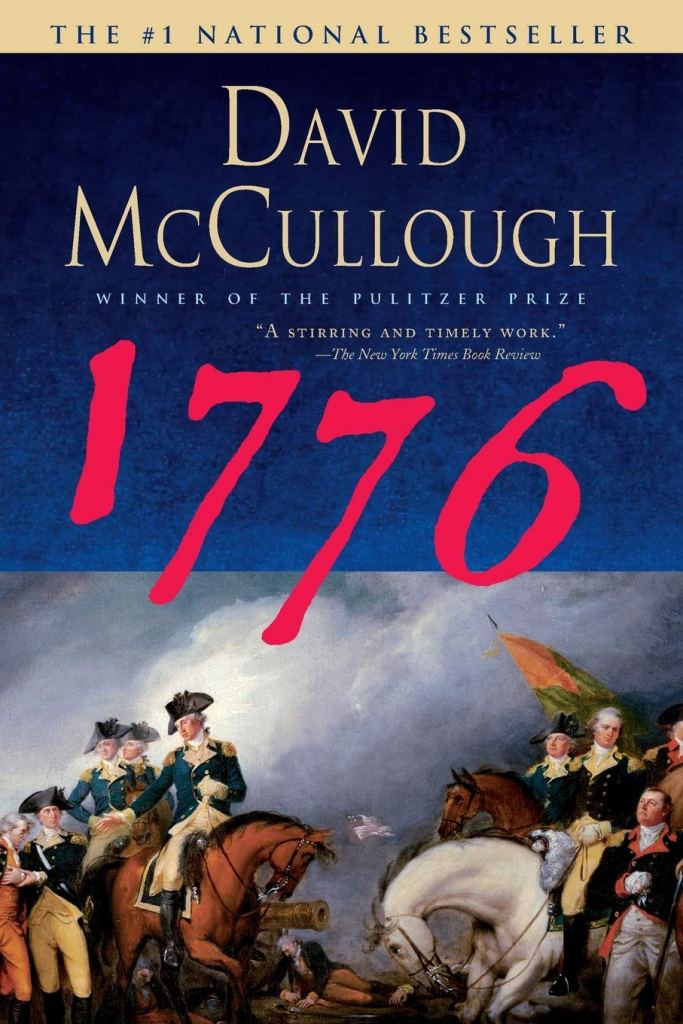
Finding 1776 in 2006

I’m not a fan of war stories. Given a choice, I much prefer to curl up with one of Jane Austen’s classics or dive into a book that is good fodder for my work, than pick up a book about war.

War stories just don’t interest me.

That was until in 2006. I was outvoted, when my book club decided to read David McCullough’s bestselling 1776, the saga of George Washington and the early days of America’s fight for independence. Suddenly, I was faced with 294 pages of war, and I wasn’t looking forward to it.

Needless to say, when we met again, it was something of a surprise to me (not to mention the rest of the group) that I was the only one who absolutely loved the book.

It was slow reading at first—all those names and details necessary to set up the narrative. But once the story got going, I was completely drawn in, so much so, that after a while I lost track of where 1776 ended and 2006 began.

McCullough reveals grim aspects of this pivotal year in American history that get left out of idealized accounts of the American Revolution. I felt my spirits sag as page after page recounted crushing defeats for Washington and his rag-tag army. They were ill-equipped, undisciplined, sick, malnourished, and bitterly cold—sometimes even shoeless—and, except for a tiny minority, devoid of military training. Their numbers declined alarmingly from massive casualties, the steady drain of defections, and a surprising lack of commitment.

I never saw the Revolutionary War that way before.

In contrast, the fine-tuned British army held the advantage from every angle. They were highly trained, heavily armed, well fed, and properly financed. Repeatedly, whenever the two armies clashed, American losses were heavy, and retreat seemed their only option. The odds were hopelessly stacked against Washington and his troops. As I continued reading, ridiculous as it sounds, I felt a growing worry inside about how everything would turn out.

It would have been nice to think God was on the side of the Americans, but that was never clear to me. Both sides could (and did) legitimately point to Providence turning the tide in their favor at one point or another. One day the wind filled the sails of the British ships and the whole fleet came bearing down on the hapless Americans. Another day fog provided thick cover for the fleeing American troops, who vanished into thin air to the consternation of the watchful redcoats. God’s purposes are more complex than simply taking sides. And in this case there were praying soldiers on both sides of the battle. I’m learning (slowly, I confess) that God’s purposes for me, as well as for his world, are advancing solidly whether I’m celebrating victory or suffering defeat.

As I read on, the lines between 1776 and 2006 began to blur, and I felt like my own story was being told. As a woman—an ezer-warrior with plenty of battles of my own—I’m often overwhelmed by the odds against me. And, despite what I know to be true about how God’s great story will ultimately turn out, when I’m grieving another defeat, I still wonder if that really applies to me.

I know I’m not alone in this.

Probably the most powerful impact of the book came as I entered into the agonies of the man at the center of the story. It may sound a little silly to some, but I actually began to feel a lot like George. In his battles, and despite his best efforts, he was often inept and indecisive. He made a string of bad decisions and missed crucial opportunities. At many points he was outsmarted and outfought. How I wish I didn’t know what that was all about. I certainly related to the description of Washington at one of his lowest moments, looking okay on the outside, while weeping in his heart.

For someone who has studied American history as many times as I have, I was wonderfully surprised by Trenton—the battle where the Americans—“battered, weary, ragged as beggars”—refused to quit and pressed on to a stunning victory that surprised them as much as it did anyone else and turned the tide of the war. Remarkably, their only casualties in this battle were two soldiers who froze to death on the march to Trenton. One historian remarked on their victory,

“It may be doubted whether so small a number of men ever employed so short a space of time with greater and more lasting effects upon the history of the world.”

From prison, Paul—who had his own share of battles to fight and understood the agony of defeat—refused to consider the odds. He pointed to the resurrection power of Christ that gives us reason to hope, no matter how badly the war is going. “I want to know Christ and the power of his resurrection and the fellowship of sharing in his sufferings” (Philippians 3:10).

I’m still not a fan of war stories. But 1776 is on my list of all time favorite books. It is a powerful reminder to me that the battles I am fighting—for my husband, my daughter, my loved ones, and the work to which God has called me—are never to be measured in terms of odds or even my own failures and shortcomings. Ultimately, it doesn’t even matter that I’m no match for the Enemy who “prowls around like a roaring lion looking for someone to devour” (1 Peter 5:8).

1776 reminds me that while I may suffer bitter defeats and may, like George, weep inwardly over casualties I couldn’t prevent, you never know when God will show up with his resurrection power, and there will be another Trenton.

Posted in Uncategorized | 1 Comment