Mentor for Life—A Review

It isn’t every day a former Marine officer and U.S. Naval Academy graduate steps up to mentor women in the church. Natasha Sistrunk Robinson has done exactly that in her excellent book, Mentor for Life: Finding Purpose through Intentional Discipleship.

Lest anyone get the wrong idea, this book does not contain anything like the kind of grueling physical boot-camp ordeal or loudmouth sergeants abusing recruits one braces for in the military. But the purpose and content are every bit as dead serious and substantial as what Marines expect (and the country counts on them getting) from those who mentor and train them.

Mentoring as Mission

Having said that, Natasha’s military background beautifully informs and shapes both her passion for others and the sense of urgency she expresses as she unfolds the mentoring plan she’s developed and tested. Strong parallels exist between those who battle for their country and the training she’s proposing for those entrusted with the good news of Jesus Christ, but who face a formidably relentless enemy.

I love how she draws on her military experiences to argue that stroView More: http://meredithmacy.pass.us/natasha-robinsonng, intentional mentoring activity is urgently needed within the body of Christ—for both women and men. This is not only for our own good, but also because of the vital mission Jesus calls us to undertake. That alone distinguishes this mentoring plan from a simple personal-betterment or educational mentoring program.

First, like military training, so also true spiritual mentoring is n
ever an end in itself. Both come within a larger pressing context. Soldiers don’t train simply for their own sakes, but because they’ve answered a call to something far bigger and more consequential than themselves. Believers too have answered a call to become part of something vast and monumental. Our smaller diverse stories are part of God’s bigger global story. We are participants in God’s mission for the world. The seriousness of this bigger context means we cannot take our own readiness lightly.

Second, because every recruit is indispensible to the whole and must be readied. Natasha argues from The 27 Laws of the Navy,

“On the strength of one link in the cable, dependeth the might of the chain.”

In the military, the chain is only as strong as its weakest link. Likewise, the Body of Christ is only as strong as its weakest member. We need each other to be strong. One unhealthy, malfunctioning, or weak member impacts the whole body. Intentional training is vital and makes us all stronger.

Third, because a certain outcome is in mind. Mentoring heart and mind with the truth of God’s word, with a deepening understanding of God’s character and ways, and with spiritual practices that nurture the soul inevitably leads to action. As God’s image bearers who follow Jesus, we bear responsibility for what happens in God’s world. Mentoring helps equip us to embrace God’s heart for the world and to engage on behalf of others for his Kingdom’s sake.

Mentor for Life is also distinct because it doesn’t come with the overwhelming burdens of a one-on-one mentoring relationship (that often results in disappointment). This is an intentional group endeavor. Not only has she written the book, she’s also written a helpful Leader’s Training Manual.

Given the challenges and battles ahead, we need all the help we can get!


8d7e0-ma-logo-horizontal-300x225      Originally published at www.MissioAlliance.org/author/carolyncustisjames

Posted in Uncategorized | Leave a comment

Double-Header in Pennsylvania

2016 Spring Pub Flyer

May  12, in Souderton, PA, 6:30-8:00am

As long as I’ve known my husband, I’ve never tired of (or ceased to marvel) at his faith journey. If you live anywhere within driving distance of Souderton, Pennsylvania (and don’t mind getting up early), you won’t want to miss hearing his hope-filled story.

Even though I tend to burn the midnight oil and can hardly be described as a “morning person,” I’m actually looking forward to getting up to hear him tell his story again. He’ll be speaking at the Spring Business and Professional breakfast event hosted by Bucks Mont Coalition for Evangelism.

For tickets, contact:

Patricia Niederhaus
Technical Administrator
Solar Atmospheres, Inc.
1983 Clearview Road
Souderton, PA 18964

267-384-5040 ex 1240
patricia@solaratm.com or bucksmontbusinessbreakfast@verizon.net

Location:

Franconia Heritage Restaurant
508 Harleysville Pike
Souderton, PA 18964


Young, Wrestling, and Always Reforming

May 3-4 in Philadelphia, PA

This event is coming up soon, but there’s still time to register. I posted details earlier (see link above). Lots of interesting topics and speakers. I guarantee they’ll make you think.

Both Frank (who is a leading Reformation scholar—and plenty others besides me will tell you that) and I are participating. I’ll be joining him for a breakout session entitled “Reimagining Women in Leadership.”

Description: Seems like everything that can be said about women in leadership has already been said, and a lot of us are bone weary of the debate. Anyone expecting this workshop to be more of the same, will be disappointed. Expect a fresh take on this worn out topic. We are moving the discussion to a new location beyond the debate and asking deeper questions that the debate often overlooks. Don’t worry—the Bible will be central to our discussion, plus church history, plus a lot of common sense.

To learn more and register, go here.

Location:

Liberti Church
123 S 17th Street
PhiladelphiaS, PA 19102

Posted in Uncategorized | Leave a comment

The Failure of Complementarian Manhood

Version 2

“There is no togetherness for the gospel when the victim stands alone.”
—James Kessler

The recent 2016 Together for the Gospel (T4G) conference in Louisville, Kentucky put on public display one of the biggest complementarian manhood failures in recent history. Not only did the leaders of this all-male organization refuse to stand by their masculinity manifesto—that “real men” are the protectors of women and children—these men circled the wagons and protected a man.

Despite many protests and appeals, T4G leaders spotlighted CJ Mahaney as a plenary speaker before an audience of 10,000. Mahaney, one of T4G’s founding members, has been living under a cloud ever since he was implicated in lawsuits alleging systemic leadership cover-ups of sexual abuse in Sovereign Grace Ministries (SGM). The lawsuit never made it to court—not because the charges from eleven plaintiffs were dropped or proven invalid, but because the statute of limitations for the sexual abuse of children in the state of Maryland ran out.

The scandal implicating Mahaney for knowing and neglecting to act on behalf of sexually abused children within his ministry (there have been convictions and prison sentences) remains an active issue in the judicial system. Mahaney (founder and former president of SGM) denies any knowledge of abuses or participation in cover-ups, although he’s still named in pending court cases. His denials—even if true—don’t change the fact that the abuses and the cover-ups took place under his watch. Besides, denials fall woefully short of the urgent, uncompromising response such a profoundly serious matter demands.

If it wasn’t bad enough for a pastor—still embroiled in an unresolved sexual abuse and cover-up scandal—to be a featured plenary speaker at T4G 2016, the cavalier way Al Mohler, Mahaney’s close friend and one of his prominent male defenders, chose to introduce him went beyond the pale.

Mohler, President of Southern Seminary in Louisville, offered a glowing tribute of his friend. He followed that endorsement by insensitively brushing up dismissively against the sexual abuse/cover-up scandal. He even evoked laughter from a predominantly male audience of 10,000 by saying “I told CJ that in getting ready to introduce him I decided I would Google to see if there was anything on the Internet about him.” He then yielded the podium to Mahaney who preached on the sufferings of Job.

One might think the topic of Job’s innocent suffering provided Mahaney with a perfect opportunity to address the innocent suffering of abuse victims both inside and outside the church and to reach out with remorse and compassion.

Instead, he focused on the suffering of pastors.

In their classic complementarian tome, Recovering Biblical Manhood and Womanhood, no less than John Piper and Wayne Grudem (the formulators of complementarianism) establish with absolute certainty that the protection of women and children is a non-negotiable criteria for true manhood.

Their illustrations are a bit odd, but their point is unmistakable. They imagine an approaching assailant with a lead pipe or a home intruder that a real man will be first to confront, even if his wife has a black belt in karate.

“Mature masculinity senses a natural, God-given responsibility to step forward and put himself between the assailant and the woman. . . . His inner sense is one of responsibility to protect her because he is a man and she is a woman. . . . Women and children are put into the lifeboats first, not because the men are necessarily better swimmers, but because of a deep sense of honorable fitness. It belongs to masculinity to accept danger to protect women.” (emphasis added)

In his sermon, “Lionhearted and Lamblike: The Christian Husband as Head” (starting at 40:10), Piper rails with damning words against the hapless overpowered husband who refuses his manly role as protector of his black belt wife, insisting, “She’s following you. . . . You’re dealing with this guy, and when you’re unconscious on the floor, she takes him out. But if you’re not unconscious on the floor, you’re no man!”

Complementarians preach this in sermons, in print, and in doctrinal statements on their websites. But based on what happened at T4G, they don’t practice what they preach.

So does this call to protect apply only to occasional episodes that statistically for most will never happen and not also even more urgently to the epidemic levels of abuse that fester unchecked and untended in the church? Is it okay for men talk in theory about imagined lead pipes and home intruders while making light of the all too real sexual abuses that currently devastate the young and vulnerable in the very churches they pastor?

Do any of them sense the disconnect in this?

From evidence that played out in public, it seems that complementarian convictions go by the wayside when one of their inner circle comes under fire. Instead of protecting women and children and sacrificially enduring harm for their sakes (as they profess in theory) their actions prove that, when it comes to a real crisis, real men protect each other.

Needless to say, the Internet exploded with outraged protests over Mohler’s hurtful words and Mahaney’s prominence—none more fiercely than what came from one of their own—PCA pastor, James Kessler:

“Look no one really wants to hear this, certainly not the 10,000 dutifully nodding through CJ Mahaney’s sermon . . . not the men standing on the stage with CJ, who have chosen an unconscionable loyalty to a friend and encouraged him to take the horns of the pulpit to preach and to rip apart the wounds of so many abused under his watch. . . . No one wants to hear about it, and I suppose that is their luxury because they are not the wounded, they are not the abused who were told to forgive and not to call the police. They are not plagued by nightmares, they are more fully functional if not more fully human. That hardness is their luxury, but it is privilege taxed from the bent backs of the humiliated, it is an arrogance woven from bruised reeds. . . . This is of course, nothing new. This abuse is decades old, but the new thing is the whitewash.”

That whitewash smacks of a whole new layer of cover-up and comes with devastating consequences—especially, but not only, for those who have suffered abuse.

How likely will it be for abuse victims to come forward, tell their stories, and seek help from the church when their ordeal is a matter of levity among the very men who (according to their own standard) should be the first to protect them?

How likely is it that the men who follow T4G’s lead will educate themselves about issues of abuse and avoid the impulse to cover-up?

How likely are they to report alleged offenders to law enforcement and seek professional help in ministering to abuse victims?

How, before a watching world, have T4G leaders cast yet another shadow over Christians who don’t share their views, but who care passionately for those who suffer and are actively engaged in acts of compassion and justice?

T4G’s featuring of Mahaney and their failure to raise an alarm about abuse of any kind has catastrophic consequences in the church. It opens the door for more innocents to suffer abuse and for more cover-ups to occur. It trivializes this unspeakable crisis. Victims are already reluctant to come forward with their stories. That becomes even harder now because the message is clear that the very leaders they might turn to for help won’t believe them or come to their defense. Furthermore, it legitimizes leaders who default to backing their cronies and, as often happens, even the perpetrators.

I do not mourn the fall of complementarian masculinity and I don’t pray for its recovery. It is a fallen brand of masculinity that dangles by the slender thread of a man’s ability to bring home the bacon, fight off a theoretical pipe wielding assailant, and take charge at home and in the church. It punishes and diminishes men who don’t measure up for reasons as commonplace and unavoidable as a job loss, a medical crisis, a divorce, a foreclosure, or simply the realities of old age. For some men, it remains perpetually out of reach. It emasculates men who receive the strength, help, and wisdom God intends for his daughters to give them.

God offers his sons something far more secure that Michael Jordan and the Malestromwill guide them to act differently when one of their brothers comes under suspicion. Surely this recent failure reveals the need for a whole new conversation about God’s calling on his sons.

T4G failed miserably to live up to their own definition of manhood. What is infinitely worse, they missed a golden opportunity to put a gospel brand of manhood on display. That brand of masculinity doesn’t come from shoring up some brotherhood unity to the exclusion of everyone outside their little circle; it won’t protect the powerful and expose the weak; it doesn’t belittle those who have suffered the egregious abuse of power and the violent exploitation of their dignity as God’s image bearers, those who will bear the scars of what they’ve suffered to their graves; it will never stoop to levity that conveys to a crowd of 10,000 mostly men that this is all no big deal.

The manhood that went missing at the T4G 2016 was the manhood Jesus embodies. He shielded the vulnerable, spoke truth to power, opposed abusers and their allies, valued and benefitted from the minds and ministries of women, and rejected the muscular power that the world admires and cherishes. Although Jesus was always a sufferer, his focus was on alleviating the suffering of others. This is the gospel—the call to put the interests of others ahead of ourselves. It reflects the fact that Jesus’ kingdom, according to his own definition, is not of this world.

Ironically, by protecting their friend, T4G leaders are failing to protect anyone. Certainly not any who have suffered sexual abuse (and some of them were present among the 10,000) and certainly not those who will experience abuse in the future. They didn’t even protect themselves, for they drew legitimate criticism and disapproval from many who have benefitted from and supported their ministries. Nor did they really protect Mahaney who the very next day went on to preach a sermon reminding church members of their “biblical mandate to stand by ‘God’s man’” and their responsibility to have “a joyful disposition to trust and protect the pastoral team.”

Complementarian men of all people should be first in line to defend the vulnerable, if they truly believe what they say. If their complementarian ideals don’t drive them to this, then surely the gospel they profess compels them to rethink what it means to be men who follow Jesus in defending the weak, shielding the vulnerable, and speaking up for those who have no voice.

Posted in Uncategorized | 67 Comments

Young, Wrestling and Always Reforming

Event Rectangle-22

Missio Alliance is coming to Philadelphia!

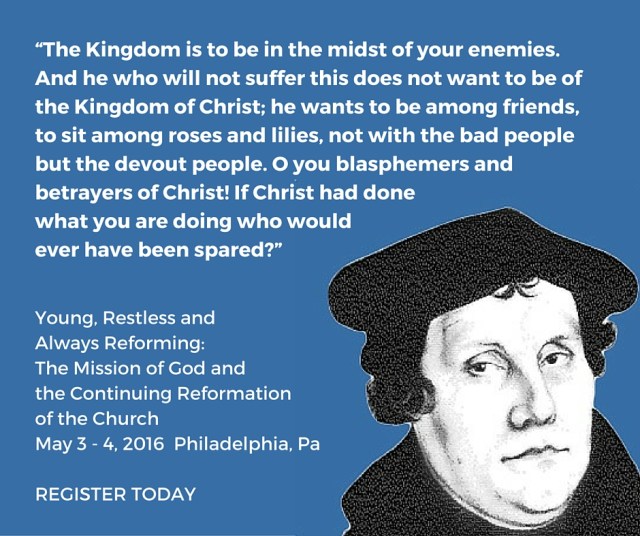
May 3-4, Missio is hosting the Young, Wrestling and Always Reforming Conference—the Mission of God and the continuing reformation of the Church.

This conference is part of Missio’s Once & Future Mission Series. If you’re anywhere near Philly, an airport, or some other form of transportation, you’ll want to head this way.

The conference includes an exclusive, pre-release screening of a portion of a new 3-part film series produced by the Christian History Institute: “This Changed Everything!” The screening takes place Tuesday evening, hosted and moderated by my favorite Church History scholar, the wonderful Dr. Frank A. James, President of BTS.

If you’ve never heard Frank speak or teach Church History, you’ve been missing out.

Missio has assembled a line-up of speakers who promise a meaty, thought-provoking conference experience. Frank and I will be presenting a workshop on “The Blessed Alliance”—a topic that challenges all of us all to be “wresting and always reforming.”

To learn more and register, go here. Hope to see you there!

Posted in Uncategorized | Leave a comment

The Masculinity Crisis

Screen Shot 2016-04-05 at 2.47.10 PM

In this fallen world, an appalling global crisis faces women and girls that is imperative for the church to engage. Our goal goes well beyond merely addressing and eradicating injustice and suffering. We must work for the full flourishing of every one of God’s daughters.

But God also has sons. And what we often fail to recognize is that they are in as much trouble as women and girls.

In staggering numbers, men and boys are marginalized, abused, trafficked, objectified, and trapped in poverty. They are on both the giving and the receiving ends of the injustice and violence we hear about every day.

Beginning this week, Discover the Word is running a series of podcasts on Malestrom: Manhood Swept into the Currents of a Changing World. This discussion takes up the subject of the current masculinity crisis.

“The malestrom is the particular ways in which the fall impacts the male of the human species—causing a man to lose himself, his identity and purpose as a man, and above all to lose sight of God’s original vision for his sons.”
—Malestrom

Every man and boy (even those who seem to have it all) is a perpetual target of the malestrom.

In researching Malestrom, I wanted to know if and how the Bible speaks into this masculinity crisis. Do we have a message for men and boys that anchors their identity, invests them with dignity and purpose, and leads to their true flourishing as God’s sons?

Mart De Haan and my good friend Elisa Morgan are the program hosts. I love interacting with them and deeply appreciate how seriously they are taking this subject. I’m only sorry you can’t see the intensity on their faces as they raise important questions and together we wade into current global issues confronting men and boys. Brian Hettinga does a masterful job of narrating the series.

This podcast series not only delves into contemporary masculinity issues, it explores how the the Bible speaks into those issues with a radical gospel/Jesus vision of manhood. That vision outstrips every definition of masculinity swirling in today’s world, including definitions often embraced by the church. Trace every current of the malestrom, and you will end up talking about patriarchy. We do that too. Our discussion includes powerful redemptive stories of men in the Bible who battle the malestrom and emerge to reveal the brand of masculinity Jesus came to recover.

149718_cf24dca07d2941dba84d2d41b26b3b68.jpg_srz_337_449_85_22_0.50_1.20_0.00_jpg_srz

Left to Right: Mart De Haan, Elisa Morgan, Brian Hettinga

This was the third time I’ve been invited to discuss my work on DTW. Previously I discussed Half the Church with hosts Haddon Robinson and Alice Mathews and The Gospel of Ruth with the current DTW team. Those podcasts are still available on the DTW website.

Malestrom podcasts are available here. Session 1:  “Let’s Begin a Study Called Malestrom” was posted on Monday, March 4. The series will continue for a couple of weeks. All sessions will be available online, so you can listen at your own pace.

This level of in-depth coverage is pretty rare. And, of course, I consider the topic to be crucially important for the men and boys we love, as well as for the health and flourishing of the church.

I hope you’ll check it out.

Posted in Uncategorized | Leave a comment

Some words are meant to last

Unfinished

It has been nearly four years since I lost my dad. Even now, those unexpected waves of grief can swallow me. There’s a moment I dread every time I return to my hometown, Portland, Oregon. It comes when I walk past the spot in the airport where he was always, always waiting for me.

I miss that hug and kiss every time.

The latest wave sent me digging through files on my computer for traces of him. We exchanged a lot of emails over the years. That’s where I found the message he wrote while he was reading my first book, When Life & Beliefs Collide, for the first time, but not the last.

Needless to say, I was anxious to learn what he thought.

He had just read the the chapter where I explain my conclusion that ezer kenegdo (a.k.a. “suitable helper” in Gen. 2:18, 20) is a warrior. Ezer is the name God gave the first female when he cast the mold for all his daughters. (See “The Return of the Ezer.”)

The starting point for my research on the meaning of the Hebrew word ezer actually began with my father’s teaching. He gave me a strong start because he believed and taught that the help God intended for his sons was spiritual in nature.

Here’s what my father wrote me:

“I have finished Chapter 9, but was not prepared for what I was to read. I have taught for a long time that Eve’s job as a helper was primarily to help Adam spiritually, but I have never gone into it like you did. I felt that you did a great job, supporting what you had to say from other parts of the Word of God. And I am sure that you are right. I suppose that will be the chapter that some men will criticize, but I hope that those who read it, will read it with an open mind and heart.”

To this day, his words still carry a potency that only a father possesses. Who knew grief could lead to fresh encouragement for me to ezer on!

Some words are meant to last.

Posted in Uncategorized | 17 Comments

Updates from Indiana

taylor4

Taylor University in Upland, Indiana is my next stop. I’m here for Taylor’s  Annual Charles Simeon Lecture Series. I’ll be speaking in chapel (Wednesday and Friday) and for two evening sessions (Wednesday and Thursday) on the Blessed Alliance. I’m looking forward to some interesting conversations about a subject of growing relevance today.


Also, just a reminder that Amazon’s special on Malestrom audio and Kindle versions P1020564.jpgends this Thursday, March 31

Read a sample and see if you don’t want to read (or listen to) the rest.

Posted in Uncategorized | Leave a comment

Why Donald Trump is Good for Evangelicals

5440392565_4634fb9d24_z

Photo credit: Gage Skidmore (http://bit.ly/1nRBAsW)

During the current race for the White House, like it or not, politicians, pundits, and the press are once again regarding evangelical Christians as a significant voting block. Currently, a good number of those evangelicals have thrown their weight behind the billionaire mogul, Donald Trump. Their support has plenty of people, including a lot of other evangelicals, scratching their heads. (Some are actually pulling out their hair.)

Trump’s arrogance, bullying, mockery, misogyny and strip club ownership, racism, Islamophobia, name-calling, put-downs, inhumane policies, disrespect for war veterans, his threat to hit back harder anyone who hits him, are blatantly antithetical to the teachings of Christianity and have nothing in common with the Jesus Christians claim to follow.

In their article, “10 Reasons You Can’t be a Christian and Vote for Donald Trump,” Baylor University sociology scholars Christopher Pieper and Matt Henderson write,

“A Christian who supports Trump either does not understand this person and his positions, or supports him in spite of Christian convictions” (emphasis added).

As Mr. Trump’s toxic rhetoric and the list of his offenses continue to pile up, growing numbers of evangelical Christians are taking Mr. Trump to task.

The topic getting the most attention centers on our core identity as evangelicals. What is an evangelical? What do we believe that connects us with Christians throughout history and elsewhere in the world? How do our beliefs impact our political convictions and loyalties? How have American values, politics, and culture wars taken our Christianity hostage and pulled us off mission? More importantly, how do we as individuals and as a body reflect the counter-cultural life, teachings, and mission of Jesus in the public square?

I welcome this development. It can be both healthy and refining for us to look in the mirror and ask ourselves honest questions about who we’ve become and how we’ve lost our way.

We have Donald Trump to thank for raising issues that compel us to reflect on what it means to be an evangelical.

One of the important (but less acknowledged) questions Mr. Trump’s candidacy raises for evangelicals concerns the definition of manhood. Much of what one hears from Donald Trump can only be described as machismo. The tougher than tough-guy posturing (threating not only to kill terrorists, but their families too) conjures up images of “El Chapo” or a mafia kingpin. Make no mistake about it, Donald Trump is a macho man. But here is the rub for evangelicals. Does the Donald really embody the evangelical conception of manhood? Three wives, mistresses, strip clubs, casinos, vulgarity, demeaning the physical appearance of women, mocking the disabled—are these manly traits Jesus would commend?

Definitions of manhood vary from culture to culture and from one era to the next. But the common thread that winds its way through every society is historic patriarchy. Patriarchy is a social system that establishes male authority over women, children, and also other males. It creates a matrix of human power pyramids where there is little room at the top and where a well-populated base is essential.

I recently finished my book on the Bible’s view of manhood,  Malestrom: Manhood Swept into the Currents of a Changing World. In it I argue that one of the greatest threats to men (as well as to women) is the lingering patriarchy that shapes much of our world. The malestrom is comprised of powerful cultural forces that drag men down and distort them from being the men God created them to be. Trace any current of the malestrom to its roots, and you’ll end up looking at patriarchy.

If I were still writing Malestrom, I would be sorely tempted to feature Donald Trump as an iconic example of a malestrom casualty.

Although the destructive effects of patriarchy on women are well-known, patriarchy is also destructive to men. The competition it produces goes beyond toxic verbal political battles. It produces the violence that began when Cain killed Abel and that we witness daily in wars, on city streets, and behind closed doors. Patriarchal notions mean manhood must be earned, that it is out of reach for some men, and that it is perpetually in jeopardy for all the rest.

Barbara Walters powerfully demonstrated that fact when she interviewed Donald Trump as one of her 10 Most fascinating People of 2015. The man who prides himself on being “successful,” “rich,” and “a winner” wasn’t prepared for what she would ask. She caught him off-guard and exposed his vulnerability to the malestrom when in her characteristic blunt manner she asked, “If you lose the Republican nomination, are you a loser?”

Stunned and momentarily deflated, Trump paused before reluctantly replying, “In a certain way, yeah. Hate to say it. If I lost the nomination, yeah, I guess I’d call myself a loser. I never said that about myself before.”

“Loser” is one of Donald Trump’s weapons of choice in his demeaning verbal arsenal. Every tactic he deploys against opposing candidates and critics is an effort to put them in the “loser” category and to preserve his status as a winner. His goal is to diminish their manhood to reinforce his own. It is a fight to maintain supremacy—to secure the top spot on the human power pyramid. It reveals Trump’s definition of what it means to be “a man.” Yet, as Walter’s revealed, his brand of manhood is fragile—hanging by the slender thread of his ability to prevail over others.

Walter’s interview forced Trump to admit the possibility that the label he so freely and cruelly attaches to others could one day be plastered to him. It was a reminder that even the top of the hierarchal human power pyramid—be it global, political, corporate, religious, domestic, or otherwise—is not a secure place.

That same vulnerability targets other men, including evangelical white males who have thrown in their lot with Trump. The realities of cultural and economic changes—the rise of women and the shift from an industrial to a service and information economy—have taken a significant toll on men who previously benefitted from a culture that catered to the skills and strengths of white males. They look to Trump because he embodies the “manliness” they’ve lost or are fearful of losing.

Kinder-gentler versions of manhood and calls for men to “man-up!” and take charge that thunder from evangelical pulpits and appear in books addressing men merely situate evangelicals on the cultural manhood continuum. Such definitions are woefully inadequate and run the risk that men, like Trump, will take things too far. Worse still, they fail to offer men and boys the indestructible identity, dignity, meaning, and purpose that their Creator intended when he bestowed the imago dei on all his sons and daughters.

Evangelicals owe Donald Trump a word of thanks. His macho candidacy actually provides the perfect opportunity to ask ourselves some serious questions. Does Donald Trump represent evangelicalism? Does his brand of manhood look anything like Jesus? Trump is raising pressings issues American evangelicals can’t ignore.

Thanks Donald for bringing patriarchy back into the conversation!


8d7e0-ma-logo-horizontal-300x225      Originally published at www.MissioAlliance.org/author/carolyncustisjames

"I hate Father's Day!"    Republished at HuffingtonPost/Religion

Posted in Uncategorized | 2 Comments

Farewell WhitbyForum


whitby-abbey-606210_1920

For years, I’ve been blogging on WhitbyForum—named for the historic 7th Century double monastery in Northumbria, England. Whitby Abbey represented the Blessed Alliance theme, for it was a double monastery where men and women (monks and nuns) were working together. But the sad fact is that the technology of my old website is outdated, and it is time to move on to something new. It has taken me a while to get this up and running and I still have more tweaking to do.

I’m sorry to see WF go, but very glad finally to be launching this new website, which I can already tell is a lot easier to use—and just in time for some important announcements.

Happening Tonight, February 29!

  • The documentary film, He Named Me Malala will air at 8ET/7CT on the National Geographic Channel. You won’t want to miss this powerful account of Malala’s journey from a little Pakistani girl who was (and still is) hungry to learn who became  a target of the Taliban and is now a global voice on behalf of education for girls, and boys too.  Read my review—“A Warrior Named Malala”—and join the effort to help raise support for the Malala Fund with tweets using the hashtag #withMalala. Every tweet adds $1 to the fund up to a total of $50,000.
  • SheLovesMagazine is hosting a live FaceBook chat on #Malestrom this evening, 9ET/8CT at The Red Couch. I am looking forward to this opportunity to discuss crucial issues that are impacting men and boys globally and the incredibly counter-cultural gospel vision of masculinity that the Bible presents. Join in if you can.

Version 2


Books on Sale!

During the month of March, Amazon is offering the eBook version Malestrom for $3.99 for the month of March

Today and tomorrow, Zondervan is offering the eBook version of When Life and Beliefs Collide February 29-March 1 for $1.99.

Posted in Uncategorized | 2 Comments

A Warrior Named Malala

4cc0d8fa-1a4c-4845-bcf7-d25931d66857_c190-901-1210-1581_r300x200

“There is a moment when you have to choose whether to be silent or to stand up.”

Malala Yousafzai

In Pakistan, family and neighbors fire rifles into the air to celebrate the birth of a son, but the birth of a daughter is met with silence. According to traditional expectations, a girl’s future will be defined by preparing food and producing children—especially sons.

This is the world into which Malala was born.

If Malala’s story had followed the traditional trajectory, today she’d be a young teenage mother of at least two children. Instead, her story followed a different path when, before she was born, her educator father, Ziauddin Yousafzai, named her after the Afghan folk hero, Malalai.

Malalai, was a young girl renown for shouting words of courage to retreating Afghan troops that led them to a great victory over the British in the Battle of Maiwand—the battle in which she died. That name instilled in Malala a sense of destiny, fueled by the love of her father and by growing up in a home where education was prized.

The film He Named Me Malala is the work of the acclaimed documentary filmmaker Davis Guggenheim (“An Inconvenient Truth,” “Waiting for Superman”). Guggenheim wisely allows the teenaged Malala to tell her own story, seamlessly weaving three strands to give a rich and honest portrayal of the young girl who has become a familiar international figure.

The public strand is captured in media footage and interviews that trace Malala’s public advocacy for girls’ education in Pakistan through the 2012 Taliban shooting. The attempted assassination nearly took her life and resulted in her family’s exile in the UK. Instead of silencing Malala, the Taliban actually amplified her voice and catapulted her onto a larger global stage, giving even greater attention to her cause. On her 16th birthday in 2013, she addressed the United Nations on behalf of education for girls. In 2014, she was awarded the Nobel Peace Prize.

The second strand traces the history of the Taliban’s rise to power in the Swat Valley, Malala’s home and the brutal enforcement of Sharia Law that terrorized entire communities and ultimately led to the complete banning of education for any girls and the bombing of over 400 schools in Pakistan.

The third strand is her family backstory—a piece of the narrative the media cameras weren’t there to capture. Recreated artistically in beautiful animation, this includes the history of her parents and early parts of Malala’s story that add insight to her rise as a passionate advocate for education.

All told, the viewer gains a rich and surprisingly candid portrayal of the girl the world has come to admire for her fighting courage and indomitable commitment to education. She is a fiercely committed schoolgirl, deeply bonded with and inspired by her father, playful and teasing with two younger brothers, and displaying social awkwardness by giggling with embarrassment when the subject of boys comes up. Even her detractors are given voice in this portrayal.

I started following Malala’s story before the shooting that escalated her cause and gave her a global voice. I also read her book, I am Malala: The Girl Who Stood Up for Education and Was Shot by the Taliban. The film is a vivid reminder that her story is not about celebrity, but about disturbing global issues that impact all of us—topics that are astonishingly absent in the current American political discourse, but that we have responsibility to engage.

Here are the takeaways for me:

Global education of girls and boys must be a priority. After her recovery, Malala visited Kenya, Nigeria, and refugees on the Jordanian/Syrian border where education for children is rare or non-existent. Today, over 60 million girls are out of school around the world. Not only the children themselves, but their societies and indeed the whole world, will pay a heavy price for this neglect. The world will be deprived of the precious human resources that remain uncultivated in the minds, gifts, and potential of these children. Who knows, our negligence may be costing us the cure for cancer or sidelining a future global leader for peace? But the poverty, marginalization, and despair that result from the lack of education is a destabilizing force that leads to violence in many regions, including our own city streets.

Adults, especially parents, have the power to inspire their children to aspire and dream. Malala’s passion was given life when her father opened to her a wider world. He gave her the name. She embraced its meaning and went beyond anything he could have hoped.

A girl becomes her best self when she embraces her true calling as a warrior for good. As a Christian, I have long been convinced that God created his daughters to be ezer-warriors. Ezer is the biblical Hebrew word that God uses in creating the first woman (see “The Return of the Ezer). Malala is an ezer-warrior of the first rank. Her fearlessness in the face of deadly Taliban opposition is breathtaking.

The rise of one small Muslim girl from a remote Pakistani village leaves me wondering as a Christian, what can the rest of us do? What would happen—how might things change for the better—if the rest of us took our lives this seriously? What if we refused to be intimidated or held back by cultural and traditional religious constraints that are welded to our gender and that tie our hands behind our backs? What potential for good might we unleash?

Watch He Named Me Malala and be inspired!


Special Showing!  Monday, Feb 29, 8/7c on the National Geographic Channel

NOTE: A $1 donation will be made to the Malala Fund for every tweet using the hashtag #withMalala through March 10, for a total of $50,000. For more information, see www.supportmalala.com


 8d7e0-ma-logo-horizontal-300x225
Published as a Leading Voice for Missio Alliance. 
To read the full article, go to MissioAllance/CarolynCustisJames


  and  by HuffingtonPost/Religion


Posted in Uncategorized | Leave a comment